Why does the timing matter so much?
The payment date is fixed, the buyer or payer is ready, and the certificate has not arrived. Without it, the payer deducts tax at the normal rate, and the extra amount is stuck until a refund. That is why people ask how long a lower deduction certificate takes before they file.
This guide shows the time at each stage, what causes delay, what helps, and what to do if the payment date comes first. For the form change itself, read Form 128 vs Form 13.
How long does each stage take?
| Stage | What happens | Typical time in our cases |
|---|---|---|
| Filing | Application filed on TRACES and e-verified | Day 0 |
| First query | The Assessing Officer asks for the computation, the nature of the transactions and supporting documents | About 5 days after filing |
| Your reply | You upload the reply and papers on the portal | About 3 days, or the same day if you are ready |
| More queries | Two rounds of queries are typical | Each round adds time |
| Certificate | Approved and available to download on TRACES | About 40 to 45 days in total |
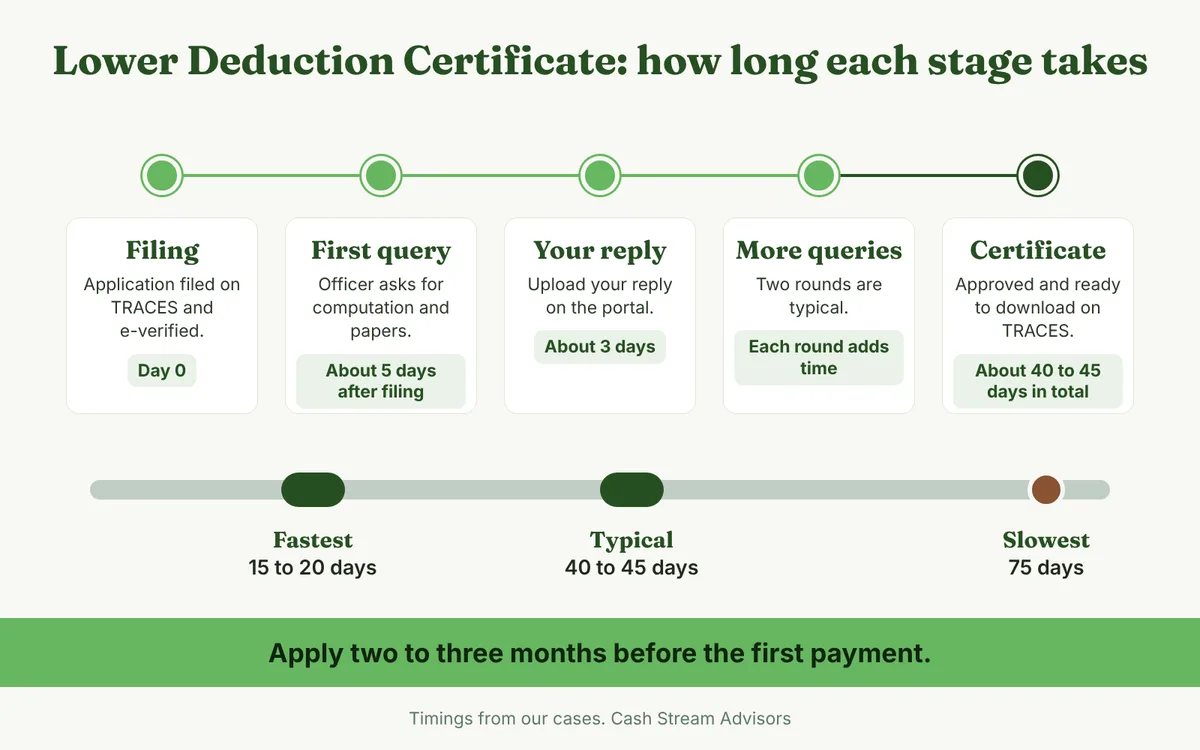
Our fastest cases came through in 15 to 20 days and the slowest took 75 days. Extra rounds of queries and the officer's workload are what move an application along that range.
Is there a time limit for the officer to decide?
CBDT Instruction No. 1/2014 of 15 January 2014 told Assessing Officers to follow the Citizens Charter and decide on Section 197 (now Section 395(1)) applications for nil or lower deduction within one month. Source: CBDT Instruction No. 1/2014, reproduced by BCAJ.
In practice, treat one month as a target. Our typical case runs longer, so plan for 40 to 45 days at least.
What causes a lower deduction certificate to be delayed?
- •Incomplete computation. An incorrect or incomplete computation is the most common cause of repeat queries.
- •Vague answers. A short reply that does not answer the officer's question brings another query.
- •Reply by email only. The reply must be uploaded on the portal, not only sent by email.
- •Missing papers. Proof of cost or an exemption claim that is not attached leads to repeat queries.
- •Officer workload. An application can move to another officer when a charge is reassigned or an officer takes an additional charge, which resets the pace.
What do officers usually ask?
Most queries fall into three groups: the computation of income and tax, the nature of the transactions, and supporting documents for the transaction. Keep all three ready before you file. Applications are rarely rejected, and a rejection usually follows when the information asked for is not given.
How can I speed it up?
- •Reply to every query the same day, and upload the reply on the portal.
- •Follow up consistently with the TDS Assessing Officer.
- •Ask for expedited disposal when the payment date is close.
- •Keep checking the status on the portal.
These help, but no one can promise a date. The safest step is to apply early.
What statuses will I see on TRACES?
| Status | What it means |
|---|---|
| Submitted | Your application is filed |
| Query raised | The officer has asked for information. Reply on the portal |
| Under processing | The officer is reviewing the application or your reply |
| Approved or rejected | The certificate is issued, or the application is closed |
What if the certificate is late and the payment date is close?
The payer deducts tax at the normal applicable rates, and the seller claims the excess back through the income tax return. A certificate cannot reduce tax that has already been deducted, because it must reach the payer before deduction. Where the contract allows, the payer can hold the next payment until the certificate arrives. For a property sale, see TDS on Sale of Property by NRI.
How early should I apply?
Apply two to three months before the first payment, whether it is a property sale or a payment to a foreign company. The typical time is 40 to 45 days, and officer queries need room.
Questions people ask about the timeline
Talk to a tax advisor about your application
Every application has its own dates, documents and officer queries. If you would like to discuss yours, you can book a consultation with a senior tax advisor at Cash Stream Advisors, message us on WhatsApp, or write to contact@cashstreamadvisors.com. You can also see our contact page.
This article is for general information and is not advice on any specific transaction. Tax rules change, and the position in your case depends on its facts. Read our disclaimer and regulatory compliance pages.