A couple who had recently moved to India from abroad came to us with a question that sounds simple: can the 12.5% long-term rate be used on their overseas portfolio? This guide covers foreign ETF taxation India residents face, and shows how the answer for UCITS tax India, foreign debt ETF tax India and alternative funds tax India depends on what the fund holds, when each unit was bought and how long it was held. It also covers capital gains on foreign funds more generally.
This article covers units of funds domiciled outside India that an Indian resident holds directly, for example a UCITS fund or a US-listed ETF. Indian mutual funds and Indian-listed ETFs that invest abroad follow different rules, including different holding periods, and are not covered here.
The short answer
Foreign ETFs and UCITS funds are not listed in India and carry no securities transaction tax, so the concessional equity rates do not apply to them. The ordinary rule does: units held for more than 24 months give long-term capital gains taxed at 12.5% without indexation (section 112 of the 1961 Act, section 197 of the 2025 Act). With the surcharge capped at 15% and 4% cess, that is about 14.95% for high earners. Units held for 24 months or less are taxed at your slab rate, up to about 39% under the new regime.
The big exception is debt. Units of a specified mutual fund, meaning one that invests more than 65% in debt and money market instruments, bought on or after 1 April 2023, are always treated as short-term, however long you hold them. Market linked debentures are always short-term too. Dividends are taxed at slab rates, and every holding must be reported in Schedule FA.
In this article
- •
- •
- •
Section 50AA and section 76 Income-tax Act 2025: the debt fund rule most investors miss
- •
- •
Dividends and withholding: US-listed ETFs versus UCITS funds
- •
- •
- •
- •
- •
A portfolio review that shows where the rules bite
The couple held about thirty funds and ETFs in an account outside India. There were global and US equity trackers, government bond ETFs, absolute return funds, a gold ETC and a commodity ETF. The transaction history ran to nearly a thousand lines over several years. Their income put them in the top surcharge bracket, so the gap between 12.5% and slab rates was real money.
The rate itself was the easy part. The hard part was finding out which units could use it. The portfolio had been actively rebalanced since 2023, so only eight of the thirty holdings still contained any unit bought before 1 April 2023. By value, about a fifth of the portfolio sat in that older group, about a quarter had been bought between April 2023 and late 2024, and a little over half was less than 24 months old. Same fund, different lots, different tax.
Four things made the review more than arithmetic:
- •
The debt funds. Most of the money in six bond funds had been bought after 1 April 2023. Whatever the holding period, those lots were likely to be deemed short-term. The older lots in one bond fund stood outside that rule.
- •
Share class conversions. There were five conversions of one share class into another at book cost. Whether a conversion is a transfer decides if the original purchase date survives. One conversion alone carried nearly a fifth of the value in the older group.
- •
The gold ETC. It looks like a commodity product, but legally it is a debt security. That raises the question of whether it is a market linked debenture or an unlisted debenture, and both are deemed short-term.
- •
The cost statement. The provider reported average cost. Indian holding periods run lot by lot, so average cost told us the gain but not the tax.
On our indicative numbers, the long-term rate on the older and mid-aged lots roughly halved the tax on the unrealised gain compared with taxing everything at slab rates. That is why the lot mapping was worth doing before anything was sold.
How each type of foreign fund is taxed
| Type of holding | Long-term after | If long-term | If short-term | What to watch |
|---|---|---|---|---|
| Foreign equity ETF or UCITS equity fund | More than 24 months | 12.5%, no indexation (up to about 14.95%) | Slab rate (up to about 39%) | No securities transaction tax, so the 111A and 112A equity rates are not available. Gains are worked out in rupees. |
| Debt ETF or bond fund, units bought before 1 April 2023 | More than 24 months | 12.5%, no indexation | Slab rate | Outside the deeming rule for those units. Keep the purchase evidence. |
| Debt ETF or bond fund, units bought on or after 1 April 2023 | Not available if the fund is a specified mutual fund | Not applicable | Slab rate, always | The 65% debt test decides. Check it year by year. |
| Absolute return, multi asset or hedge style UCITS | More than 24 months | 12.5% if not a specified mutual fund | Slab rate | The label does not matter. The fund's actual debt share does. |
| Gold or commodity ETC | Depends on legal form | 12.5% if an ordinary capital asset held over 24 months | Slab rate | Many ETCs are debt securities. They may be market linked debentures or unlisted bonds. |
| Structured notes | Not available if a market linked debenture | Not applicable | Slab rate, always | No acquisition date cut-off for market linked debentures. |
| Dividends and distributions | Not applicable | Not applicable | Slab rate (about 36% for high earners) | Taxed when received. Credit for foreign tax deducted from your own payment, through Form 67 or Form 44. |
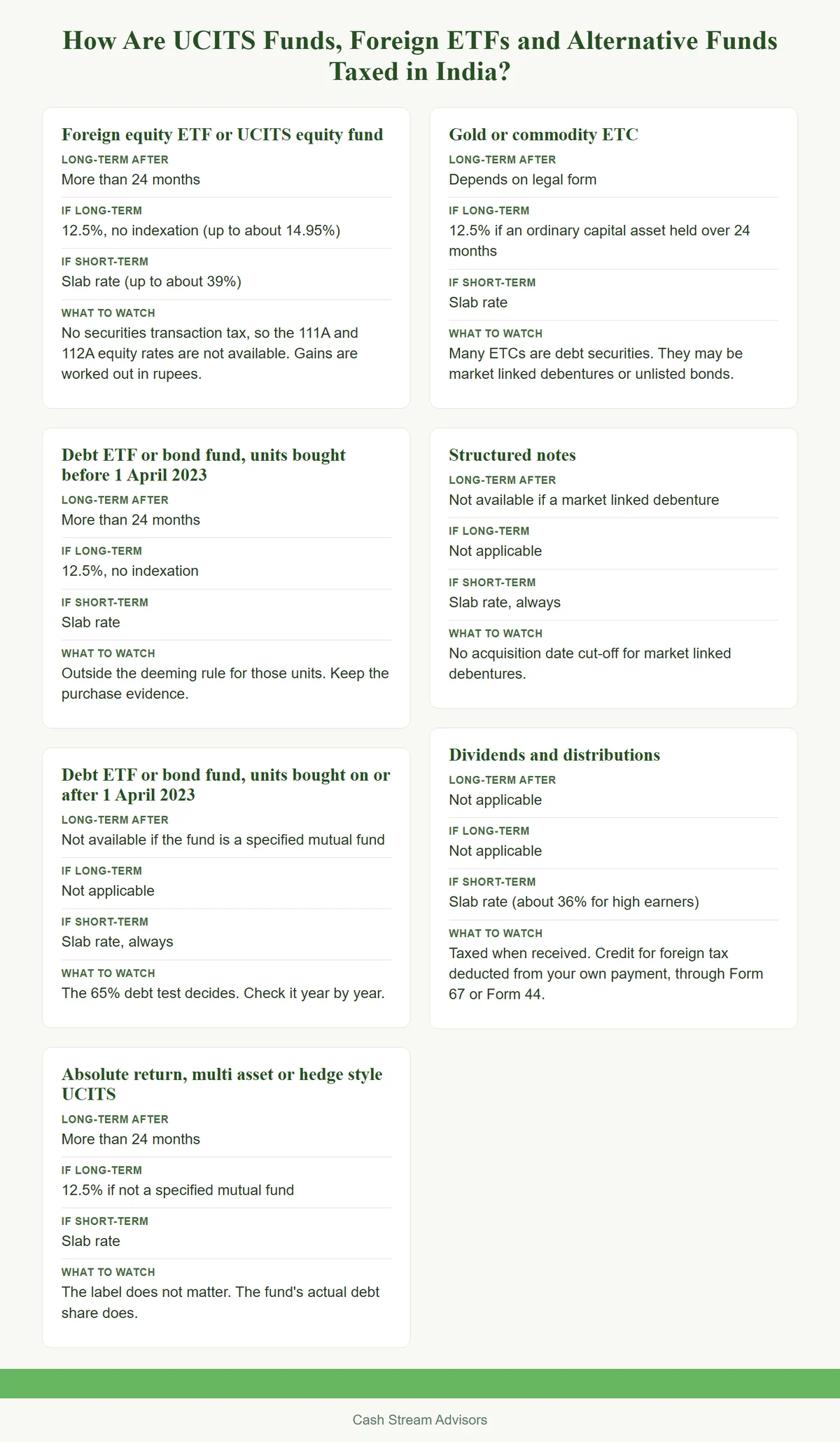
Rates assume a resident individual in the highest surcharge bracket. A lower income means a lower effective rate.
Section 50AA and section 76 Income-tax Act 2025: the debt fund rule most investors miss
For tax years up to 2025-26 the rule is section 50AA of the Income-tax Act, 1961. From 1 April 2026 it is section 76 of the Income-tax Act, 2025, headed "Special provision for computation of capital gains in case of Market Linked Debenture". The substance is the same. Three kinds of asset are deemed to give short-term capital gains, however long you hold them:
- •
Units of a specified mutual fund acquired on or after 1 April 2023. A specified mutual fund invests more than 65% of its proceeds in debt and money market instruments. A fund that puts 65% or more into units of such a fund also counts. The 65% is measured on the annual average of daily closing figures.
- •
Market linked debentures. These are debt securities whose return follows an index or market. There is no acquisition date cut-off.
- •
Unlisted bonds and debentures. These are caught when transferred, redeemed or matured on or after 23 July 2024.
Two dates and one percentage do most of the work: 1 April 2023, 23 July 2024 and 65%. If your units were bought before 1 April 2023, the deeming rule for fund units does not reach them, whatever the fund holds. That is the reason we map every lot by purchase date before saying anything about rates. Some older articles describe the rule by reference to funds with 35% or less in Indian equity, which is the earlier wording, so read the current text.
Does the rule reach foreign funds? The provision speaks of a mutual fund without limiting it to Indian funds, and the Income-tax Act does not define the term for this purpose. One argument is that a foreign UCITS is not a mutual fund at all. That argument is untested, and we would not rely on it without a documented position. The safer working assumption is that a debt oriented foreign fund can be caught.
Send your statements and fund list and we will map each lot by purchase date. For a quick review, send us: the transaction history, the fund ISINs and share class documents, and the Schedule FA copy from your last return. Book a Consultation with Cash Stream Advisors.
Alternative funds and ETCs: where the label misleads
Absolute return funds, multi asset funds and hedge style UCITS are not debt funds by name, but the test looks at what the fund actually owns. A strategy built around government bonds can sit above 65% debt for the year even though it is sold as alternative. A fund that is below 65% in one year can cross it in the next, because the test uses the yearly average.
In practice that means collecting the fund's annual report or portfolio data for each year you held it, and keeping a note of the result. Factsheets alone rarely show the daily average. Where the fund cannot evidence its debt share, the position should be documented as a judgement and not presented as certain.
Gold and commodity products need a different question: what is the legal form? Many gold ETCs are debt securities issued by a vehicle that holds the metal. Depending on their terms, they may be market linked debentures, which are always short-term, or unlisted debentures, which are short-term on transfer from 23 July 2024. Read the product terms before assuming the 24 month rule.
Dividends and withholding: US-listed ETFs versus UCITS funds
Dividends are taxed in India at slab rates whatever the fund type, but who bears the foreign tax, and whether it can be credited, differs.
| Holding | Typical foreign tax | Where it arises | Credit in India |
|---|---|---|---|
| US-listed ETF | 25% US withholding on ordinary dividends with a valid Form W-8BEN | Deducted from the investor's payment | Generally creditable, with Form 67 or Form 44 |
| Irish UCITS ETF holding US shares (distributing) | 15% US withholding commonly applies inside the fund; no Irish withholding on payment to a non-resident investor in many cases | Suffered by the fund before the investor is paid | Generally not creditable by the investor |
| Accumulating UCITS class | Same fund-level tax; no cash paid out | Inside the fund | Nothing to credit now. Gain taxed on sale |
The gross dividend credited to the investor is the income reported in India. Tax withheld from the investor's own payment may be claimed as a credit; tax borne inside a fund generally cannot. For an accumulating class, the usual view is that no dividend income arises until units are sold, but the fund's terms should be checked, and this is a working position and not an express exemption. For the credit mechanics, read Foreign Tax Credit in India: Form 67, Form 44 and US Form 1116 Explained.
Tax is worked out lot by lot
Every purchase is its own lot with its own date. A fund you added to in 2022, 2024 and 2026 has three holding periods, and what you sell first decides which tax rate you meet.
- •
Which lot is sold first. The Indian default for demat securities is first in, first out. Whether that applies to a foreign custody account is not settled, so state your assumption and test it.
- •
Average cost on a statement. Providers often show average cost. It will not match first in, first out, and it says nothing about holding periods.
- •
Share class conversions. Moving between classes of the same fund at book cost may or may not be a transfer. Until that is clear, treat the older purchase date as supportable but not guaranteed.
- •
Reinvested distributions. If distributions buy new units, each purchase is a new lot with a new date.
- •
Rupee conversion. Gains are computed in rupees. Under Rule 115, the sale proceeds are converted at the SBI telegraphic transfer buying rate on the last day of the month before the month of transfer. The conversion of the cost is not free from doubt, and practice is to use the same method for the month of purchase, so the method used should be stated and applied consistently. A portfolio that looks like a modest gain in the fund's currency can show a larger gain in rupees.
- •
No exemption and loss set-off. The INR 1.25 lakh exemption on listed Indian equity does not apply to foreign funds. A short-term capital loss can be set off against short-term or long-term gains. A long-term capital loss can be set off only against long-term gains, and any balance is carried forward.
Examples, with the tax in rupees
Three cases show the rule:
- •
Equity ETF bought in January 2023, sold now. Held for more than 24 months and outside the deeming rule. Long-term gain, taxed at 12.5%.
- •
Bond fund bought in January 2024, sold now. Bought after 1 April 2023 in a debt oriented fund. Deemed short-term, taxed at slab rate, even though held for almost three years.
- •
Equity fund bought in January 2025, sold now. Short-term at slab rate until January 2027, then long-term at 12.5%.
Illustration (hypothetical, round numbers): a gain of INR 10,00,000 for a top-bracket individual under the new regime.
| Case (gain INR 10,00,000) | Rate used | Tax |
|---|---|---|
| Equity ETF held more than 24 months | 12.5% + 15% surcharge + 4% cess = 14.95% | INR 1,49,500 |
| Bond ETF bought after 1 April 2023 | Slab 30% + 25% surcharge + 4% cess = 39% | INR 3,90,000 |
| Equity ETF held 24 months or less | 39% | INR 3,90,000 |
The same gain can cost INR 2,40,500 more if the lot is deemed short-term. The surcharge rates and the top slab rate are those for the year of sale, so confirm them before relying on the figures.
Residency decides whether any of this applies
A resident and ordinarily resident individual is taxed in India on worldwide income. A resident but not ordinarily resident individual generally is not taxed on gains from assets held abroad. People who move to India often spend a few years in the second category, which can make timing of sales important. Becoming resident gives no step up in cost, so a gain that built up before the move is taxed when you sell in an ordinarily resident year. Confirm your status for each year before you plan sales, and do not assume it from the date you arrived. For returning residents, read our NRI Tax and Relocation page.
A separate US issue applies to US-listed funds. A non-US-domiciled individual with US-situs assets worth more than USD 60,000 can face US estate tax at rates from 18% to 40%, and India has no estate tax treaty with the US. Irish and Luxembourg domiciled UCITS funds are generally outside US situs assets. This deserves its own advice, and US estate tax UCITS planning should be confirmed with a US adviser.
Reporting, FAST-DS 2026 foreign assets and timing
- •
Schedule FA foreign ETF reporting. A resident and ordinarily resident taxpayer reports every foreign asset in Schedule FA, whether or not any units were sold. Schedule FA is reported on the calendar year ending 31 December, while tax is on the financial year, and readers often mix these up.
- •
Schedule FSI and the foreign tax credit form. Foreign income and any foreign tax credit go in Schedule FSI. The credit is claimed in Form 67 for income up to 31 March 2026, and in Form 44 under Rule 76 of the Income-tax Rules, 2026 for income from 1 April 2026, with relief under section 159 or section 160 of the 2025 Act.
- •
Black Money Act. Failing to disclose a foreign asset can attract a penalty of INR 10 lakh for the year. The Finance (No. 2) Act, 2024 raised the relief limit from INR 5 lakh to INR 20 lakh, so no penalty applies where the total value of foreign assets, other than immovable property, did not exceed that limit.
- •
Advance tax. Capital gains attract advance tax in the quarter in which they arise. Sales during the year can leave an unpaid instalment, so plan before you sell.
- •
Earlier years. If you were already ordinarily resident in earlier years, check how past sales and distributions were reported before you file for the current year.
- •
Sending money abroad. The Liberalised Remittance Scheme limit is USD 250,000 a year per resident individual. Tax collected at source is 20% on the amount above INR 10 lakh a year for investment purposes, adjustable against tax payable, and Budget 2026 left that unchanged. Sale proceeds and income received abroad generally need to be reinvested or brought back within 180 days.
FAST-DS 2026: a window to regularise unreported foreign assets. Residents who did not report foreign assets in earlier returns can use the Foreign Assets of Small Taxpayers Disclosure Scheme, 2026, notified on 14 August 2026 and open from 16 August 2026. Form 1 must be filed by 31 December 2026, with assets valued as at 31 March 2026.
- •
Undisclosed foreign income or assets, up to INR 1 crore: 30% tax plus an additional amount equal to 100% of the tax, 60% in all.
- •
Assets bought from income already taxed in India (or earned abroad as a non-resident) but left out of Schedule FA, up to INR 5 crore: a flat fee of INR 1 lakh.
A valid declaration with payment gives immunity from the penalty and prosecution provisions of the Black Money Act for the declared assets. Whether a particular fund or account qualifies depends on the facts. Book a Consultation with Cash Stream Advisors before the window closes.
A check before you sell
- 1
Is my status ordinarily resident for this year, or resident but not ordinarily resident?
- 2
For each fund, is it mainly equity, mainly debt, or something else? What does its annual report show on the 65% test?
- 3
What is the purchase date of each lot, and does any lot predate 1 April 2023?
- 4
Has any fund had a share class conversion or merger that could reset the purchase date?
- 5
Are any holdings ETCs, notes or other debt securities that may be market linked debentures or unlisted debentures?
- 6
Which lot will actually be sold first, and which method do I rely on?
- 7
What are the gains in rupees, using the SBI rate under Rule 115?
- 8
Are all of these holdings and the income from them reported in Schedule FA and Schedule FSI?
If you hold a foreign portfolio
If you are resident in India and hold foreign funds, ETFs or alternatives, the useful first step is a lot level map of your holdings: what you own, what each fund invests in, and when each lot was bought. It tells you which rate each lot is likely to meet before you sell anything. Book a Consultation with Cash Stream Advisors to talk through your portfolio.
Talk to an advisor
This Insights article is general information, not advice on a specific transaction. Read our disclaimer and regulatory compliance pages.
Official references
- Income-tax Act, 2025, Section 76: deemed short-term capital gains (specified mutual fund, market linked debenture, unlisted bond)
- Income-tax Act, 2025, Section 197: tax on long-term capital gains at 12.5%
- Income-tax Act, 1961, Section 50AA: special provision for specified mutual fund units and market linked debentures
- Income Tax Department: Rule 115, rate of exchange for converting foreign currency
- Income-tax Act, 2025, Section 159: foreign tax credit
- Income-tax Act, 2025, Section 160: foreign tax credit, countries without an agreement
- Income-tax Rules, 2026, Rule 76: foreign tax credit and Form 44
- Income Tax Department: Notification No. 114/2026 (FAST-DS Rules, 2026)
- Income Tax Department: FAST-DS FAQs
NRI Tax & Relocation
Residency status and tax planning for moving to or from India., handled so it does not become the subject of your next article.