A software engineer returns to Bengaluru after years in the US. Her last RSU batch vests in the first year back, and the US employer has already withheld tax. India now taxes her on the same income as a resident. Without a claim, she pays twice. The claim has a form, a deadline and an exchange-rate rule, and each is easy to get wrong.
The short answer
Form 67 is the online statement a resident taxpayer files to claim credit in India for tax paid abroad on income India also taxes, for AY 2026-27 and earlier. You may see it called Form 67 income tax, Form 67 of Income Tax Act or Form 67 ITR, but it is one foreign tax credit Form 67, filed separately from the return. From tax year 2026-27 the form is Form 44 under Rule 76. The credit is the lower of the foreign tax and the Indian tax on that income. For the treaty basics, read What Is DTAA? How the Double Tax Avoidance Agreement Works in India.
Who can claim and who cannot
Only a person who is resident in India for the year can claim foreign tax credit in India, and only on income that India also taxes. A resident is taxed in India on world income, so tax already paid abroad on the same income would otherwise be a second tax.
- •
Resident taxpayers with foreign salary, RSUs, rent, dividends, interest or business income.
- •
Income offered to tax in India. If the income is exempt in India, no credit is allowed.
- •
Non-residents are out, because India does not tax their foreign income.
- •
Returning NRIs and RNORs depend on what is taxable in India in the year. An RNOR is not taxed in India on foreign income that is not from a business controlled in India or a profession set up in India, so there is nothing to credit on that income.
How to claim foreign tax credit in India: how the credit is worked out
The credit is the lower of the foreign tax and the Indian tax on the same income. If the foreign tax is higher, the extra is lost. If it is lower, you pay the balance in India. Rule 76 works it out separately for each source of income.
- •
Which section. Sections 90 and 90A for treaty countries and Section 91 for others, under the 1961 Act. From 2026-27 these are Sections 159 and 160 of the Income-tax Act 2025.
- •
Treaty cap. Where a treaty limits the tax that can be charged abroad, the tax above that limit is ignored. Ask the foreign payer to apply the lower rate at the start.
- •
Not credited. Interest, fees and penalties, and tax on exempt income.
- •
Exchange rate. The State Bank of India telegraphic transfer buying rate on the last day of the month before the month in which the tax was paid or deducted. For Form 44, Rule 76 refers to Rule 207 for the meaning of the rate.
Illustration (hypothetical, round numbers): a resident Indian employee receives US stock units that vest. The US employer withholds ₹3 lakh of tax at source, and the employee reports the income in his Indian return. The Indian tax on that income is ₹2.5 lakh. The credit is ₹2.5 lakh, the lower figure, and the extra ₹50,000 of US tax is not credited in India. Where the Indian tax is higher, he pays the difference in India.
Form 67 or Form 44: which one applies
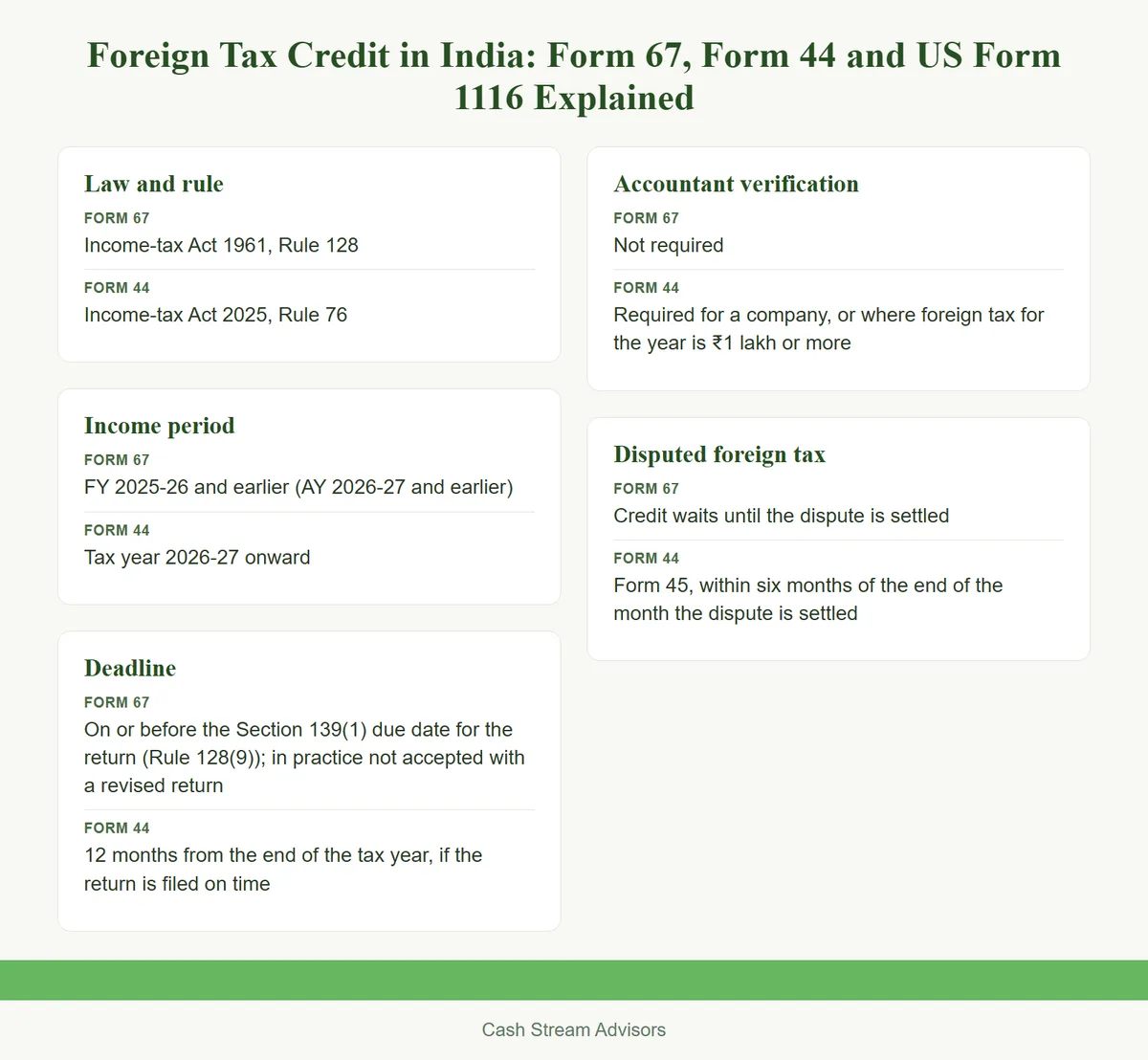
Form 67 covers AY 2026-27 and earlier, and Form 44 covers tax year 2026-27 onward. For the other forms that changed with the new Act, read Form 10F (Now Form 41): When You Need It and How to File It Online.
| Point | Form 67 | Form 44 |
|---|---|---|
| Law and rule | Income-tax Act 1961, Rule 128 | Income-tax Act 2025, Rule 76 |
| Income period | FY 2025-26 and earlier (AY 2026-27 and earlier) | Tax year 2026-27 onward |
| Deadline | On or before the Section 139(1) due date for the return (Rule 128(9)); in practice not accepted with a revised return | 12 months from the end of the tax year, if the return is filed on time |
| Accountant verification | Not required | Required for a company, or where foreign tax for the year is ₹1 lakh or more |
| Disputed foreign tax | Credit waits until the dispute is settled | Form 45, within six months of the end of the month the dispute is settled |
Form 67 due date: when to file and the deadline conflict
File Form 67 before the original return, and no later than the due date under Section 139(1). That is what Rule 128(9) says, and it is our advice. In practice the form is generally not accepted with a revised return, and a credit claimed without it may be denied by the processing system.
The courts have been more flexible. The Bangalore Tribunal in Shashank Shekhar v. ITO (AY 2017-18) held that the time limit is directory, not mandatory, because neither Sections 90 and 91 nor Rule 128 deny the credit for late filing. It sent the claim back to the officer to decide on merits. That is a Tribunal view, and an officer may still disagree, so treat the due date as the safe course.
For Form 44, the position is different. It is due 12 months from the end of the tax year, and only where the return itself was filed on time under Section 263(1) or 263(4). A person who moves from 2025-26 to 2026-27 should not assume the same timing.
How to file, step by step
- 1
Gather proof. The foreign return or statement, and evidence that tax was paid or deducted, such as a payslip, Form 1042-S or a tax certificate.
- 2
Convert the tax at the State Bank of India rate set out above.
- 3
Log in to the e-Filing portal and open the income tax forms section.
- 4
Fill the form: the income and foreign tax details, and the credit worked out. Attach the documents.
- 5
Verify the form electronically.
- 6
Report the same figures in the return, in Schedule FSI and Schedule TR, and in Schedule FA where foreign assets are held.
- 7
Keep the file for the assessment.
What does not qualify and where claims go wrong
- 1
No form filed with the return. Fix: file before the due date.
- 2
Exempt income. Fix: check whether the income is taxable in India first.
- 3
Disputed foreign tax. Fix: use Form 45 under the new rules once it is settled.
- 4
Tax above the treaty cap. Fix: get the right rate applied abroad.
- 5
A mismatch between the form and Schedule TR. Fix: use the same figures in both.
- 6
Wrong exchange rate. Fix: use the State Bank of India rate for the month before.
- 7
No proof. Fix: keep the certificate with the form.
If you also file in the US: Form 1116 side by side
A person taxed in both countries makes two separate claims: one in India and one in the US. Form 1116 is the US form for the Indian tax paid. This page is not a US guide, and the India-USA DTAA guide covers the treaty side.
| Point | Indian claim (Form 67 or 44) | US claim (Form 1116) |
|---|---|---|
| Who claims | Indian resident | US resident or citizen |
| Credit limit | Lower of foreign tax and Indian tax on that income | Lower of foreign tax and US tax on foreign-source income, by category of income |
| Treaty cap | Tax above the cap is ignored | Only a legal and actual liability is creditable |
| Unused credit | Foreign tax above the Indian tax is not credited | Back one year, forward ten |
| Where reported | The form, Schedule FSI and Schedule TR | Form 1116 with Form 1040 |
Talk to us
If you are a returning NRI or hold RSUs and need to claim credit in both countries, speak to us before you file. Message us on WhatsApp or use our contact page.
Talk to an advisor
This Insights article is general information, not advice on a specific transaction. Read our disclaimer and regulatory compliance pages.
DTAA Advisory service
SERVICEInternational Taxation
INSIGHTSWhat Is DTAA? How the Double Tax Avoidance Agreement Works in India
INSIGHTSForm 10F (Now Form 41): When You Need It and How to File It Online
INSIGHTSIndia-USA DTAA: Treaty Rates, Forms and How to Claim Them
INSIGHTSNRI Rental Income From India and DTAA: How to Avoid Paying Tax Twice
INSIGHTSTDS on NRO Interest and Dividends: How to Claim the Treaty Rate
INSIGHTSIndia-UK DTAA: Treaty Rates, Pensions and How to Claim Them
SERVICEAll insights
ABOUTAbout Cash Stream Advisors
CONTACTContact us
Official references
- Income-tax Act 2025, Section 159: agreement with foreign countries and treaty relief
- Income-tax Act 2025, Section 160: countries with which no agreement exists
- Income-tax Act 2025, Section 263
- Income-tax Rules 2026, Rule 76: foreign tax credit
- Income Tax Department: Forms 44 and 45 FAQs
- IRS: About Form 1116, Foreign Tax Credit
DTAA Advisory
Treaty relief and TRC compliance for cross-border income., handled so it does not become the subject of your next article.