Your NRO account statement shows interest of ₹5 lakh, and the bank has already kept ₹1.56 lakh of it. A friend in another country says his bank took far less. The difference is usually the treaty, and whether the right papers reached the bank before the interest was credited. This guide explains NRO account tax on interest and dividends, and how to claim the treaty rate.
The short answer
Interest on an NRO account is taxable in India, and the bank deducts 30% plus surcharge and cess, which is 31.2% where no surcharge applies. A treaty rate can be lower, but only if the bank holds your tax residency certificate and Form 41 before the interest is credited. Otherwise you claim the excess back. To get the papers right, read Tax Residency Certificate (TRC) for DTAA: Who Issues It and What India Needs and Form 10F (Now Form 41): When You Need It and How to File It Online.
Who this affects
- •
An NRI with an NRO deposit or savings account whose interest is taxed at source.
- •
An NRI who holds Indian shares and receives dividends.
- •
A family member who manages an NRI's accounts in India.
What the bank deducts and why
The bank deducts tax at the rate in force for a non-resident under Section 393(2) of the Income-tax Act 2025 (old Section 195). For NRO interest that is 30% plus cess, with surcharge added as income rises, so 31.2% where no surcharge applies. This is why a search for tax in NRO account or tds on nro account interest usually ends at the same number.
TDS is not the final tax. It is a deduction at the highest normal rate on gross interest, whatever your real tax liability. Your actual tax is worked out in your Indian return, and the difference comes back as a refund. For the refund timeline, see our NRI TDS refund guides.
Illustration (hypothetical, round numbers): an NRI earns ₹5 lakh of interest on NRO fixed deposits. At 31.2%, the bank deducts ₹1.56 lakh. If the NRI is a tax resident of a country whose treaty caps interest at 15%, the treaty rate would give ₹75,000. If the NRI's total Indian income is low, the actual tax on the return can be lower still. This is the kind of figure to run through an NRO account tax calculator before you decide what to claim, and the actual tax always depends on your other Indian income.
The same rule applies to tax on interest on NRO account balances held as fixed deposits. TDS on NRO fixed deposit interest is deducted when the interest is credited or paid, and many banks deduct it at each quarter end.
The treaty rate by country
A treaty rate is a cap. The bank may deduct at the treaty rate if it holds your papers, and the domestic rate applies where it is lower. Surcharge and cess are not added to a treaty rate. For all corridors side by side, read India DTAA Rates and Countries: Dividend, Interest, Royalty and Fees.
| Country | Interest | Dividends | Checked |
|---|---|---|---|
| United States | 10% for a bank or similar lender; 15% otherwise | 15% if the recipient company holds 10% or more of voting stock; 25% otherwise | 23 Nov 2026 |
| United Kingdom | 10% for a bank; 15% otherwise | 10%; 15% for property-income dividends | 23 Nov 2026 |
| UAE | 5% for a bank or financial institution; 12.5% otherwise | 10% | 23 Nov 2026 |
| Singapore | 10% for a bank or similar lender; 15% otherwise | 10% if the recipient company holds 25% or more; 15% otherwise | 23 Nov 2026 |
| Canada | 15% | 15% if the recipient company controls 10% or more of votes; 25% otherwise | 23 Nov 2026 |
| Australia | 15% | 15% | 23 Nov 2026 |
| Germany | 10% | 10% | 23 Nov 2026 |
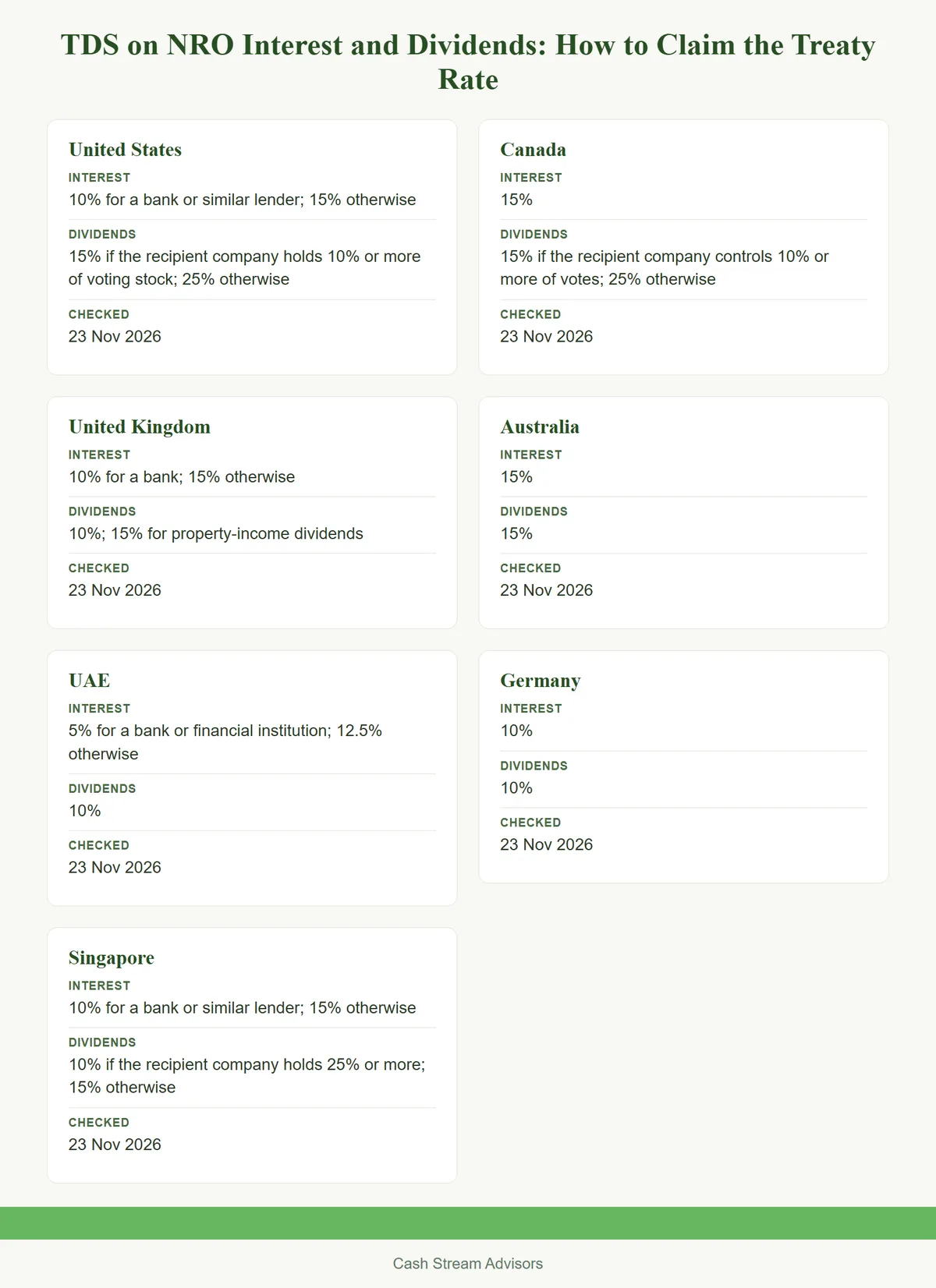
For an individual NRI, the dividend cap is the higher figure where a holding test applies. Country detail is in India-USA DTAA: Treaty Rates, Forms and How to Claim Them, India-UK DTAA, India-UAE DTAA, India-Singapore DTAA and India-Germany DTAA. Caps only: read the treaty and the latest protocol before you rely on a figure.
What the bank needs from you
The bank needs your tax residency certificate and Form 41 (old Form 10F) before the interest is credited. In our experience some banks accept them and others do not. Banks that do usually also ask for a no-PE declaration and a copy of your PAN, and some ask for more.
- 1
Residency certificate from your country's tax authority, for the year.
- 2
Form 41 filed on the e-Filing portal, with the acknowledgement.
- 3
No-PE declaration on the bank's format.
- 4
PAN copy and the bank's annexure.
- 5
Renew every year, because the certificate and declaration are for a period.
If the bank refuses, the interest is taxed at the full rate. You then claim the excess back in your return, and Form 128 can reduce the deduction in later years. Ask the bank for its decision in writing, and take it to the bank's nodal officer if the papers were complete.
If the treaty rate is still too high: Form 128 and the refund
Form 128 is for the future. It asks the Department to authorise a lower or nil deduction under Section 395, replacing the old certificate under Section 197, and a computation of your estimated income and tax goes with it. Apply before the year starts. For timing, read NRI Rental Income From India and DTAA: How to Avoid Paying Tax Twice.
The return and the refund cover the past. File your Indian return, report the interest, and claim credit for the TDS.
A condonation request is for a past year in which no refund was claimed through the return. It asks the Department to excuse the delay, under the Board's power to relax time limits (old Section 119(2)(b)) and the guidelines in CBDT Circular 11/2024. It is discretionary and rests with the competent authority, who decides by the amount of refund involved. Applications are not entertained beyond five years from the end of the assessment year, so it is slower and harder than filing on time.
Forms 15G and 15H do not work for NRIs. They are for residents.
Dividends
An Indian company deducts 20% plus surcharge and cess on dividends paid to an NRI. The treaty can cap this at 10% or 15%, depending on the country, if the company holds your tax residency certificate and Form 41 before the dividend is paid. For the US corridor in detail, read India-USA DTAA.
Illustration (hypothetical): a US-resident NRI holds shares in an Indian company through a demat account, and the company deducts 20% on the dividend. The US cap for a portfolio holder is 25%, which is higher than the domestic rate, so the lower domestic rate applies. The residency certificate and Form 41 matter more where the treaty cap is lower than 20%.
Where claims go wrong
- 1
Residency certificate late. Fix: hold it before the first credit of the year.
- 2
Wrong form. Fix: use Form 41 and the bank's format, not Form 15G or 15H.
- 3
Bank not updating its records. Fix: ask for written confirmation of the rate applied.
- 4
No return filed. Fix: file to claim the refund.
- 5
No credit claimed at home. Fix: use the foreign tax credit form. See Foreign Tax Credit in India: Form 67, Form 44 and US Form 1116 Explained.
Illustration (hypothetical, not a client matter): an NRI hands in the residency certificate in March, but the bank has already deducted at the full rate on the year's interest. He files his return in July, claims the refund and keeps a note to give the documents in April next year.
Talk to us
If you have excess TDS on NRO interest or a bank that will not accept your papers, speak to us. Message us on WhatsApp or use our contact page.
Talk to an advisor
This Insights article is general information, not advice on a specific transaction. Read our disclaimer and regulatory compliance pages.
DTAA Advisory service
SERVICENRI Tax and Relocation Advisory
INSIGHTSTax Residency Certificate (TRC) for DTAA: Who Issues It and What India Needs
INSIGHTSForm 10F (Now Form 41): When You Need It and How to File It Online
INSIGHTSIndia DTAA Rates and Countries: Dividend, Interest, Royalty and Fees
INSIGHTSNRI Rental Income From India and DTAA: How to Avoid Paying Tax Twice
INSIGHTSForeign Tax Credit in India: Form 67, Form 44 and US Form 1116 Explained
SERVICEAll insights
ABOUTAbout Cash Stream Advisors
CONTACTContact us
Official references
DTAA Advisory
Treaty relief and TRC compliance for cross-border income., handled so it does not become the subject of your next article.