A German parent sends a licence fee invoice to its Indian subsidiary, and the finance team asks which rate applies. A German engineer spends eight months at a customer's plant in India, and nobody asks whether that creates a taxable presence. Both questions are answered by the India Germany DTAA, and both are easier to settle before the money moves.
The short answer
India and Germany signed their tax treaty at Bonn in 1995. The DTAA between India and Germany caps India's tax at 10% on dividends, interest, royalties and fees for technical services. A German company can still create a permanent establishment in India, for example on a building site lasting over six months. To claim the rate, you need a German residence certificate and Form 41. For the papers, read Tax Residency Certificate (TRC) for DTAA: Who Issues It and What India Needs and Form 10F (Now Form 41): When You Need It and How to File It Online.
Who this affects
- •
A German-resident NRI with Indian income or investments.
- •
A German company with Indian customers, a project or staff in India.
- •
An Indian company paying a German parent, technology partner or vendor.
Rates at a glance
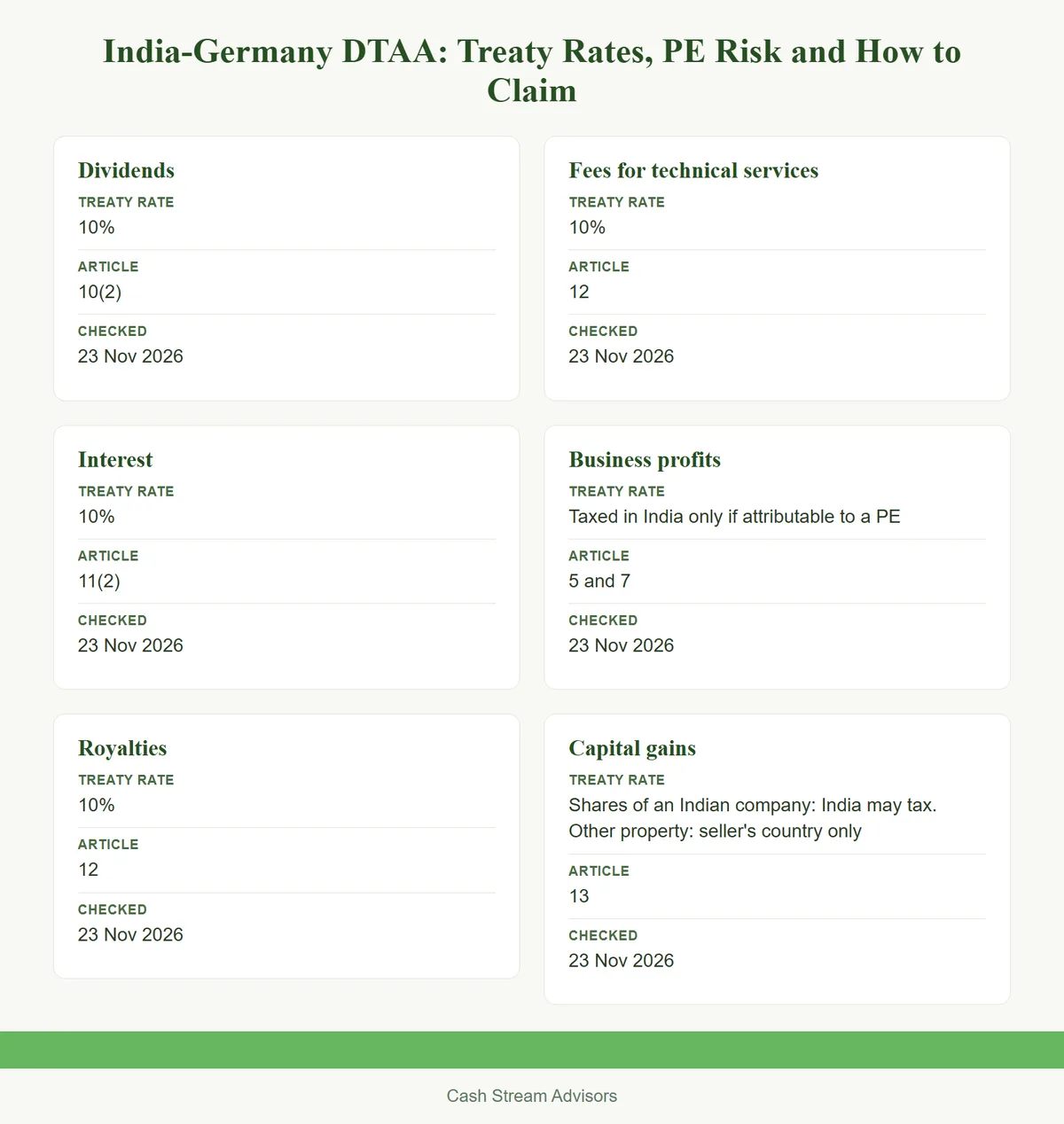
A treaty rate caps India's tax. The payer deducts at the lower of the treaty and domestic rate, and surcharge and cess are not added. For all countries side by side, read India DTAA Rates and Countries: Dividend, Interest, Royalty and Fees.
| Income | Treaty rate | Article | Checked |
|---|---|---|---|
| Dividends | 10% | 10(2) | 23 Nov 2026 |
| Interest | 10% | 11(2) | 23 Nov 2026 |
| Royalties | 10% | 12 | 23 Nov 2026 |
| Fees for technical services | 10% | 12 | 23 Nov 2026 |
| Business profits | Taxed in India only if attributable to a PE | 5 and 7 | 23 Nov 2026 |
| Capital gains | Shares of an Indian company: India may tax. Other property: seller's country only | 13 | 23 Nov 2026 |
Interest paid to specified Indian and German public institutions is exempt under Article 11(3).
Capital gains on Indian shares
Article 13(4) says gains on shares of a company resident in India may be taxed in India. Article 13(5) says gains on other property are taxable only in the country where the seller is resident. A German resident selling Indian shares can therefore be taxed in India, and Germany then relieves the double tax under Article 23.
How to claim from India
- 1
German certificate of residence from the German tax office (Finanzamt).
- 2
Form 41 (old Form 10F) on the e-Filing portal. It is required even though the certificate has been issued.
- 3
No-PE declaration where the payer asks.
- 4
Remittance forms. Form 145 (old Form 15CA) is the payer's declaration. Form 146 (old Form 15CB) is a Chartered Accountant's certificate, with a UDIN, needed where the taxable payment to a non-resident is above ₹5 lakh in a year. If the payer files Part B of Form 145 with an assessing officer's certificate, Form 146 is not needed. If the treaty is claimed, the certificate number is quoted.
- 5
The payer applies the treaty rate.
German payer to an Indian recipient
For royalties paid from Germany, the German payer withholds tax under German law unless an exemption certificate has been obtained from the Federal Central Tax Office (BZSt). Check the process with the German payer's adviser, because it is German law and not part of the treaty.
Indian payer to a German recipient
Hold the German residence certificate, Form 41, the no-PE declaration, the contract showing the nature of the payment, and the Form 145 and 146 filings.
A German-resident NRI
An Indian citizen resident in Germany should obtain the residence certificate for each year, file Form 41, and keep proof of tax paid in Germany for credit claims. For the wider NRI position, read the NRI tax pages on this site.
PE risk for German companies
Article 5 treats a fixed place of business as a PE. A building site, or construction, installation or assembly project with supervisory activities, becomes a PE if it lasts more than six months (Article 5(2)(i)). A dependent person who habitually concludes contracts, delivers from stock or secures orders can also create one, but a genuinely independent agent does not (Article 5(5) and (6)). The text has no general clause on services through employees, which only appears for mineral oil activities.
Illustration (hypothetical, not a client matter): a German company sends an engineer to work at a customer's plant in India for many months, using the customer's desk and access card. The question is whether the plant becomes a fixed place of business at the company's disposal, and whether the engineer's role goes beyond preparatory work. We review the contract, duration and control before the secondment starts.
Fees for technical services and management fees
Article 12(4) defines fees for technical services as payments for managerial, technical or consultancy services, taxed at up to 10% at source. The text does not use the words "make available", and the Protocol has no item on Article 12. In our view a management fee for services is business profits under Article 7, taxable in India only if there is a PE. The two readings lead to different tax, so the contract, the service and the evidence decide.
Illustration (hypothetical, not a client matter): an Indian company pays a German technology partner for a licence to use a patented process. This is a royalty, capped at 10% under Article 12. The payer should apply 10%, not the domestic rate, once the German certificate and Form 41 are in hand.
Where claims go wrong
- 1
Applying 10% without the German certificate. Fix: get it before the first payment.
- 2
Adding surcharge and cess to a treaty rate. Fix: the treaty rate is the cap.
- 3
Calling a management fee a technical fee without reading the contract. Fix: test Article 7 and Article 12.
- 4
Ignoring the six-month project test. Fix: track the project duration from the start.
- 5
No Form 145 or 146 for the remittance. Fix: complete them before the bank pays.
Talk to us
If you are a German-resident NRI, or a German or Indian company with payments across the border, talk to us before the payment. Message us on WhatsApp.
Talk to an advisor
This Insights article is general information, not advice on a specific transaction. Read our disclaimer and regulatory compliance pages.
DTAA Advisory service
SERVICENRI Tax and Relocation Advisory
INSIGHTSTax Residency Certificate (TRC) for DTAA: Who Issues It and What India Needs
INSIGHTSForm 10F (Now Form 41): When You Need It and How to File It Online
INSIGHTSIndia DTAA Rates and Countries: Dividend, Interest, Royalty and Fees
INSIGHTSRoyalty vs Fees for Technical Services Under a Treaty: The Make Available Test
INSIGHTSPermanent Establishment Under a Tax Treaty: Test, Risk and Profit Attribution
SERVICEAll insights
ABOUTAbout Cash Stream Advisors
CONTACTContact us
Official references
DTAA Advisory
Treaty relief and TRC compliance for cross-border income., handled so it does not become the subject of your next article.