A payer in India asks for one paper before it will apply the treaty rate, and the payment waits until it arrives. That paper is the tax residency certificate. Most delays we see are not about the treaty at all. They are about a certificate that is late, wrongly dated, or missing a detail India expects.
The short answer
A TRC is the paper a tax authority issues to say you are its tax resident. To claim a treaty rate in India, you hand it to the payer, together with Form 41 (old Form 10F). It comes from the country where you live, not from India. It helps, but it is not conclusive proof.
What is tax residency certificate, and who needs one?
If you are asking what is tax residency certificate in India, the answer is that it is the other country's statement that you are its resident for treaty purposes. Three people need one.
- •
A foreign payee (an NRI or a foreign company) who wants the treaty rate on income earned in India.
- •
An Indian resident who wants relief abroad and needs India to certify residence.
- •
A payer in India, who must collect the certificate before paying at the treaty rate.
A TRC is not India's residential status test. Residential status under the Income-tax Act decides how India taxes you. The TRC is the other country's statement that you are its resident for treaty purposes. For the treaty basics, read What Is DTAA? How the Double Tax Avoidance Agreement Works in India.
Tax residency certificate India requires: what must be on it
For a treaty claim, tax residency certificate India rules expect the certificate and Form 41 together to show the particulars below. Where the certificate lacks one, Form 41, the self-declaration, can supply it.
| Particular | Why it matters | If the TRC lacks it |
|---|---|---|
| Name and status | Identifies the person claiming | Give it in Form 41 |
| Nationality or country of incorporation | Fixes who the treaty covers | Give it in Form 41 |
| Tax identification number | Links the certificate to the taxpayer | Give it in Form 41, or use another unique number |
| Period of residence | The claim must fall inside it | Get a new certificate for the right period |
| Address | Shows where the person lives | Give it in Form 41 |
| Issuing authority and signature | Shows the certificate is genuine | Get it reissued |
For how to file the form, read Form 10F (Now Form 41): When You Need It and How to File It Online.
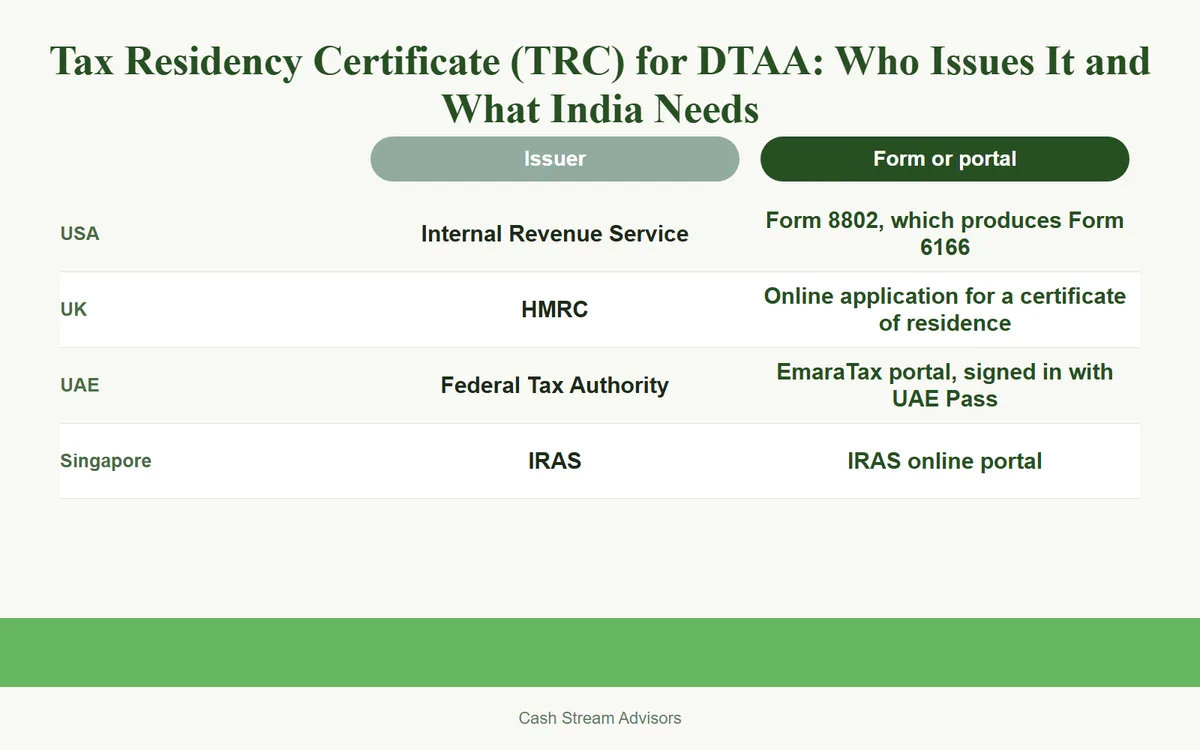
How to get a TRC: US, UK, UAE, Singapore
The time depends on the country and on the documents the authority asks for. The times below are what we see in practice, and the rules were read on the issuers' own pages. Fees are left out because they change.
| Country | Issuer | Form or portal | Usual time | Validity |
|---|---|---|---|---|
| USA | Internal Revenue Service | Form 8802, which produces Form 6166 | About 5 to 6 weeks | Shown on the certificate |
| UK | HMRC | Online application for a certificate of residence | About 2 months | The period you ask for. You cannot ask for a future period |
| UAE | Federal Tax Authority | EmaraTax portal, signed in with UAE Pass | About 6 weeks in our experience | A tax period or any 12-month period you choose. Not future |
| Singapore | IRAS | IRAS online portal | Generally within 1 week | Shown on the certificate |
One India-specific note for each of the first three:
- •
USA: the IRS says Form 8802 must be mailed or faxed, and an application uploaded to Pay.gov alone is not processed.
- •
UK: HMRC will not issue a certificate if you are not entitled to treaty benefits, and for later years it asks for your days in the UK.
- •
UAE: a company must have been established for at least 12 months, and foreign branches and offshore companies are not eligible. The Federal Tax Authority states that a complete application is generally handled in 10 business days, so plan for the longer time we see in practice but expect it to be faster if the file is complete.
Indian residents: Form 42 and Form 43
An Indian resident who needs a certificate abroad applies on the income tax e-Filing portal in Form 42 (old Form 10FA, the form many people still search for as Form 10FA). The Assessing Officer issues the certificate in Form 43 (old Form 10FB). Both are under Rule 75. The papers depend on who is applying, so follow the Department's FAQ for a company or an individual. For a company, expect the certificate of incorporation, a PAN copy, and a declaration that the company is resident in India. In our experience it takes two to four weeks. Form 42 is filed online only and cannot be edited after submission, but it can be withdrawn and refiled.
What goes wrong and how to fix it
The two causes that come up most are invalid documentation and documentation not filed on time. Five causes, with fixes:
- 1
Invalid documentation. The certificate or papers do not meet what India needs. Fix: check each particular before you file.
- 2
Documents not filed on time. The payer deducts at the normal rate because the papers arrived late. Fix: collect the TRC and Form 41 before the first payment.
- 3
Wrong period. The certificate does not cover the income year. Fix: get a certificate for the right period.
- 4
Missing tax identification number. Fix: use another unique number the payer accepts, or give it in Form 41.
- 5
Expired certificate or wrong entity. Fix: check validity and the name before you file.
For the form itself, read Form 10F (Now Form 41): When You Need It and How to File It Online.
No TRC, or an incomplete one
Without a TRC, the payer should not apply the treaty rate on the papers alone. It deducts at the normal rate. The payee can then ask the Assessing Officer for a lower deduction certificate (Section 395 of the Income-tax Act 2025, old Section 197), or claim the difference in the return once the certificate is in hand.
A TRC is also not the end of the matter. After the Supreme Court's Tiger Global judgment of 15 January 2026, a TRC is still required but is not conclusive evidence of entitlement to the treaty. For structures, the Court looked at where control and management sit, the commercial rationale, and economic substance. For an individual, practical points include where the person actually lives and works, how long they stay there, whether they own a company or a house there, and where they do business. For payer TDS, speak to us about the Withholding Tax Advisory service. If the amount is large, speak to us before you pay. Message us on WhatsApp.
Validity and renewal
A TRC covers the period it states, so check each year. A certificate for one year does not cover the next. Get the next one in time for the first payment of the new year, and make sure the period and the name match the claim.
Talk to an advisor
If your certificate is late, wrongly dated or incomplete, message us on WhatsApp, book a consultation, or write to contact@cashstreamadvisors.com.
This Insights article is general information, not advice on a specific transaction. Read our disclaimer and regulatory compliance pages.
DTAA Advisory service
INSIGHTSWhat Is DTAA? How the Double Tax Avoidance Agreement Works in India
INSIGHTSForm 10F (Now Form 41): When You Need It and How to File It Online
INSIGHTSIndia-USA DTAA: Treaty Rates, Forms and How to Claim Them
SERVICEAll insights
ABOUTAbout Cash Stream Advisors
CONTACTContact us
Official references
- Income-tax Act 2025, Section 159: agreement with foreign countries and treaty relief
- Income-tax Rules 2026, Rule 75: documents for claiming relief under Section 159
- Income Tax Department: Form 41 FAQs
- Income Tax Department: Form 42 FAQs
- IRS: About Form 8802, Application for U.S. Residency Certification
- HMRC: Apply for a certificate of residence or letter of confirmation
- UAE Federal Tax Authority: Issuance of a tax residency certificate
- IRAS: Apply for Certificate of Residence
- DLA Piper: Supreme Court ruling on Tiger Global, tax treaty eligibility and indirect share transfers
DTAA Advisory
Treaty relief and TRC compliance for cross-border income., handled so it does not become the subject of your next article.