Most people meet the question when a payment is about to cross a border. A bank deducts tax on interest, a foreign client withholds tax on a fee, or a payer in India asks for papers before it will apply a lower rate. Behind each of these sits one idea. So, what is DTAA, and how does it work in India?
The short answer
DTAA is the Double Taxation Avoidance Agreement, a treaty between two countries. In plain terms, the double taxation avoidance agreement decides which country may tax which income, and how the other country gives relief, so that the same income is not taxed twice. It shares or limits taxing rights. It does not usually make income tax-free.
How a DTAA works: one example
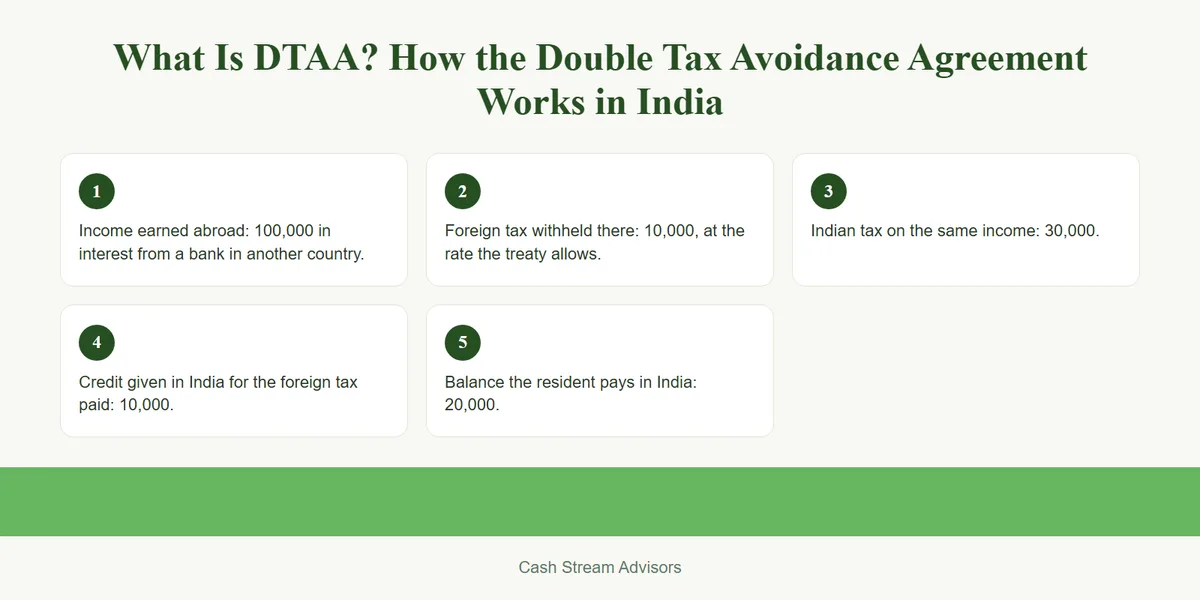
Take an Indian resident who earns interest of 100,000 from a bank in another country. That country taxes it at the rate the treaty allows, and 10,000 is withheld there. India also taxes the interest in the resident's hands, and the Indian tax on it comes to 30,000. The treaty does not make the income tax-free. Instead, India gives credit for the 10,000 already paid, so the resident pays the remaining 20,000 in India.
- 1
Income earned abroad: 100,000 in interest from a bank in another country.
- 2
Foreign tax withheld there: 10,000, at the rate the treaty allows.
- 3
Indian tax on the same income: 30,000.
- 4
Credit given in India for the foreign tax paid: 10,000.
- 5
Balance the resident pays in India: 20,000.
The same logic works the other way. A foreign investor earning income in India is taxed here at the treaty-limited rate, and the investor's home country gives relief for it. The figures above are round numbers chosen to show the logic. They are not a treaty rate.
This is what people mean when they search for DTAA income tax: the income tax result of a cross-border payment, after the treaty has done its work.
The two relief methods: exemption and credit
Under the exemption method, the country of residence does not tax the foreign income at all. Under the credit method, it taxes the income but deducts the foreign tax already paid, up to the amount of its own tax on that income.
In the treaties our clients use most, India gives relief to its residents by credit, which the treaty text words as a deduction from Indian tax. This is so in the treaties with the US (Article 25), the UK (Article 24), the UAE (Article 25), Singapore (Article 25), Mauritius (Article 23) and Germany (Article 23). The UK and Germany articles are subject to Indian domestic law. The other country may relieve its own residents by exemption for some income. Germany, for example, uses exemption or credit depending on the income type. The treaty article for the income in question decides.
Section 90 Income Tax Act and Section 91 Income Tax Act, now Section 159 and Section 160
Readers still search the old numbers, so here are both. Under the Income-tax Act 1961, Section 90 (with Section 90A) gave relief under a treaty, which is why people look up the Section 90 Income Tax Act provisions. The Section 91 Income Tax Act provision gave relief where no treaty exists. Under the Income-tax Act 2025, which applies from 1 April 2026, treaty relief is in Section 159 and unilateral relief is in Section 160. If you are searching for the Section 159 Income Tax Act 2025 rules, they are the successor to the old Section 90.
For 2026-27 and later years, cite the new sections and forms. For earlier years, the old sections and forms still apply.
| Old Act (1961) | New Act (2025) | What it covers |
|---|---|---|
| Section 90 and 90A | Section 159 | Treaty relief. Government power to enter agreements, and the claim for relief |
| Section 91 | Section 160 | Relief where there is no treaty |
| Form 10F | Form 41 (Rule 75) | Declaration of treaty particulars by a non-resident |
| Form 67 | Form 44 (Rule 76) | Statement of foreign income and foreign tax credit by a resident |
| Forms 10FA and 10FB | Forms 42 and 43 (Rule 75) | Indian residence certificate: application and certificate |
Treaty or Indian law: which applies?
You may use whichever is more beneficial: the treaty or the Act (Section 159(4), old Section 90(2)). Two conditions apply. A non-resident must hold a certificate of residence from the other country, plus the prescribed papers (Section 159(8), old Section 90(4)). And the anti-avoidance rules in the Act can still apply, because a treaty is not meant to create non-taxation.
Who can claim, and what you need
A resident of a treaty country can claim. The papers are:
- •
A tax residency certificate from that country, see Tax Residency Certificate for DTAA: Who Issues It and What India Needs
- •
Form 41 (old Form 10F), filed online by the non-resident, even where the certificate is held, see Form 10F (Now Form 41): When You Need It and How to File It Online
- •
PAN where there is one, and proof of the income and the tax paid
- •
Form 44 (old Form 67) for an Indian resident claiming foreign tax credit under Rule 76
Form 41 is a self-declaration that cannot be edited after submission. It is filed for the tax year of the claim, together with the residence certificate. Form 44 is due within 12 months from the end of the relevant tax year, and a chartered accountant verifies it for companies, or for others when the foreign tax is 1 lakh rupees or more.
Three things go wrong often:
- •
The residence certificate was missing, or it was held but nothing backed it: no evidence of substance and no paper trail behind the claim.
- •
The income was treated as business profits when it was really other-source income, so the wrong treaty article was relied on.
- •
The Form 10F, now Form 41, was never filed.
Where to go next
Start with Tax Residency Certificate for DTAA: Who Issues It and What India Needs, then Form 10F (Now Form 41): When You Need It and How to File It Online. For the largest treaty our clients use, read India-USA DTAA: Treaty Rates, Forms and How to Claim Them.
When to ask an adviser
The paper alone is not always enough. If a claim has been denied, the amounts are large, or there is a permanent establishment risk, speak to an adviser before you file. We do not promise any outcome.
Talk to an advisor
This Insights article is general information, not advice on a specific transaction. Read our disclaimer and regulatory compliance pages.
DTAA Advisory service
INSIGHTSTax Residency Certificate for DTAA: Who Issues It and What India Needs
INSIGHTSForm 10F (Now Form 41): When You Need It and How to File It Online
INSIGHTSIndia-USA DTAA: Treaty Rates, Forms and How to Claim Them
SERVICEAll insights
ABOUTAbout Cash Stream Advisors
CONTACTContact us
Official references
- Income-tax Act 2025, Section 159: agreement with foreign countries and treaty relief
- Income-tax Act 2025, Section 160: countries with which no agreement exists
- Income-tax Rules 2026, Rule 75: documents for claiming relief under Section 159
- Income Tax Department: Form 41 FAQs
- PwC Worldwide Tax Summaries: India, foreign tax relief and tax treaties
DTAA Advisory
Treaty relief and TRC compliance for cross-border income., handled so it does not become the subject of your next article.