Money moves between India and the United States in both directions every day: rent and interest to NRIs in the US, software fees and royalties to US vendors, dividends from Indian subsidiaries. Each payment raises the same question. What does the India-USA DTAA allow, and what do you need to prove before you get the lower rate?
The short answer
The India US DTAA, signed in 1989, caps the tax each country can charge at source on dividends, interest, royalties and fees, and lets the resident country give credit for tax paid. You claim it with a tax residency certificate and, in India, Form 41 (old Form 10F). US citizens stay taxable in the US. For the basics of any treaty, read What Is DTAA? How the Double Tax Avoidance Agreement Works in India.
People look for this treaty under several names: the India US tax treaty, the US India tax treaty, or the DTAA between India and USA. They all mean the same convention.
Who this affects
- •
An NRI in the US with India income (rent, interest, dividends or sale proceeds). See claiming from India and from the US below.
- •
An Indian company paying a US vendor for software, services or royalty. See royalties and fees below.
- •
A US citizen or green card holder with India income. See the savings clause below.
Rates at a glance
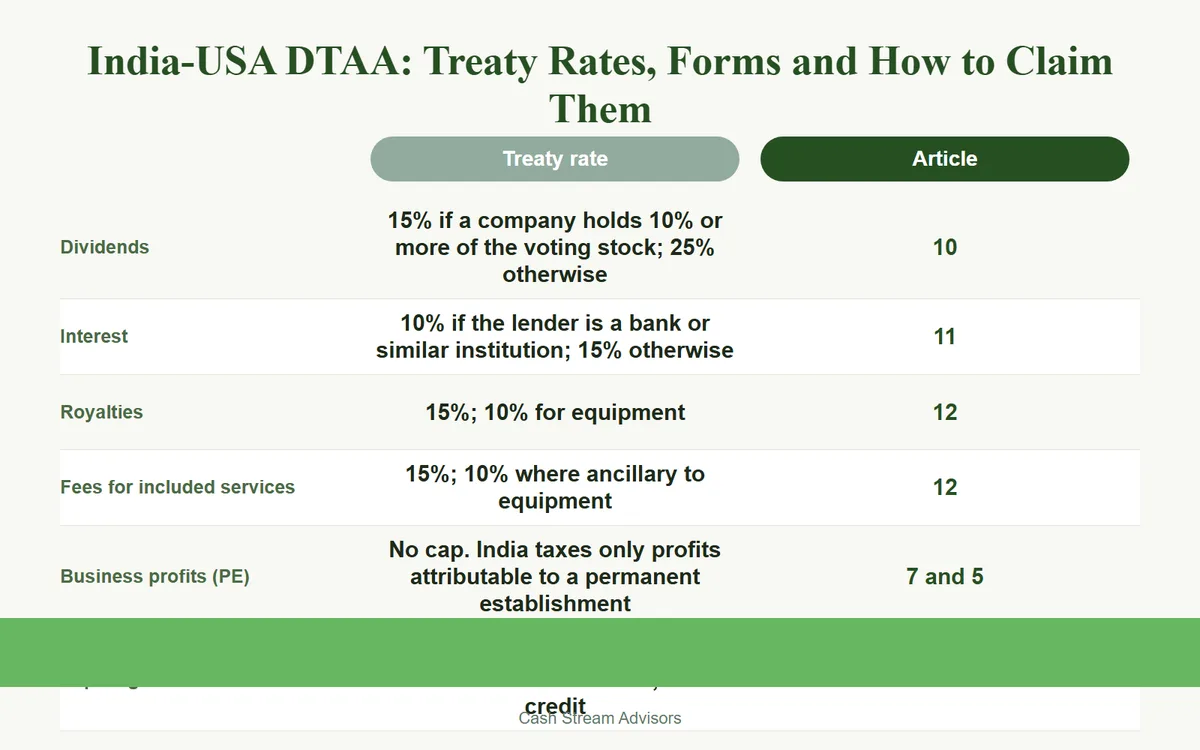
The treaty rate is a cap on India's tax, not the tax you pay. The payer deducts at the lower of the treaty and domestic rate, and surcharge and cess are not added to a treaty rate. The domestic column follows the Income Tax Department's rate chart, checked on 21 November 2026.
| Income | Treaty rate | Article | India domestic |
|---|---|---|---|
| Dividends | 15% if a company holds 10% or more of the voting stock; 25% otherwise | 10 | 20% before surcharge and cess; 10% in some cases |
| Interest | 10% if the lender is a bank or similar institution; 15% otherwise | 11 | 20% before surcharge and cess; 5% or 10% in some cases |
| Royalties | 15%; 10% for equipment | 12 | 20% before surcharge and cess |
| Fees for included services | 15%; 10% where ancillary to equipment | 12 | 20% before surcharge and cess |
| Business profits (PE) | No cap. India taxes only profits attributable to a permanent establishment | 7 and 5 | Normal rates |
| Capital gains | No cap. Each country generally taxes under its own law, with credit | 13 | Under domestic law |
How to claim from India
- 1
Get the US residency certificate. The US issues it as Form 6166 after an application on Form 8802. See Tax Residency Certificate for DTAA: Who Issues It and What India Needs.
- 2
File Form 41 (old Form 10F) on the Income Tax e-Filing portal. It is required even though the certificate has been issued. See Form 10F (Now Form 41): When You Need It and How to File It Online.
- 3
Give the payer the papers before payment: the certificate, Form 41, your PAN or tax identification number, and a no-PE declaration if the payer asks.
- 4
The payer applies the treaty rate before it deducts tax.
- 5
For an NRI with an Indian bank, the bank may ask for its own declaration alongside these papers.
How to claim from the US
Four things sit on the US side.
| Item | Used by | What it does |
|---|---|---|
| Form W-8BEN (W-8BEN-E for entities) | A person or entity being paid by a US payer | Claims a reduced treaty withholding rate on US-source income; needs a US or foreign taxpayer identification number |
| Form 1116 | US citizens and residents with Indian income | Claims credit for Indian income tax against US tax; capped at the US tax on the same foreign-source income |
| Form 8833 | A filer whose treaty position overrides or changes the US Code | Discloses the treaty-based position. A penalty can apply for failing to disclose, and some positions, such as reduced withholding, are excepted |
| Savings clause (Article 1(3)) | US citizens and residents | The US may tax them as if the treaty did not exist, except for the Article 25 credit, non-discrimination and similar provisions |
The credit comes from Article 25. A US company that owns 10% or more of the voting shares of an Indian company can also claim a deemed-paid credit.
Can you file US taxes from India? Yes. A US citizen or resident living in India files the US return from India.
Royalties and fees for included services
Under Article 12 of the treaty, a technical or consultancy service is an included service if it makes available technical knowledge, experience, skill, know-how or processes. In plain words, the service is "made available" when the provider transfers the knowledge to the Indian recipient from scratch, and trains it enough that the recipient can do the work properly without the original provider. A routine service that leaves the recipient dependent on the provider is not included.
Software and technical services are argued both ways, because the line between a service, a licence and a transfer of know-how is thin. The two rulings below show it.
When the treaty does not help
- •
Limitation of benefits (Article 24), a US company. It must pass one test. First, more than 50% of each class of its shares is owned by qualifying owners, and its income is not used in substantial part for deductible payments to non-qualifying persons. Second, it is engaged in an active trade or business in the US and the income is connected with it. Third, its main class of shares trades substantially and regularly on a recognised exchange. The competent authority can also grant benefits at its discretion.
- •
Limitation of benefits, a US citizen or individual. An individual resident gets the benefits without a further LOB test. The savings clause still lets the US tax a citizen on worldwide income, so the rate caps do not reduce US tax.
- •
A conduit company. A US company that only routes income for a third-country owner fails the tests above.
- •
A PE. If the business has a permanent establishment in India, India taxes the profit attributable to it, not at a treaty cap.
- •
Substance. A residency certificate does not close the question. The Supreme Court's Tiger Global ruling of 15 January 2026 treats it as not conclusive.
Where claims go wrong
Five common mistakes, with fixes:
- 1
Certificate without substance. Fix: build the audit trail before you claim the rate.
- 2
Wrong income type. Fix: decide whether the payment is royalty, a fee for included services or business profits before the rate is chosen.
- 3
No Form 41, or filed late. Fix: file it before the payment.
- 4
Assuming the treaty caps US tax for a US citizen. Fix: read the savings clause first.
- 5
No Form 8833 where one is required. Fix: check the position before the return is filed.
Two published rulings show how a make-available claim can go either way. These are public Delhi High Court decisions, not our cases.
- •
Cross charges. In Aecom Technical Services Inc. v. ITO, [2025] 305 Taxman 234, the Delhi High Court held that cross charges paid to a US group company were not included services. They did not make technical knowledge available, and a nil withholding certificate was directed. The Supreme Court dismissed the Revenue's special leave petition in 2026.
- •
Secondment. On 18 June 2026 the Delhi High Court held, in a case involving Ernst & Young U.S. LLP, that cost-to-cost reimbursements for staff seconded by a US firm to its Indian affiliates were taxable as fees for included services, because knowledge was transferred. The ruling is reported to be under challenge in the Supreme Court, so check its current status before relying on it.
Talk to us
If you are a US-linked NRI or a cross-border payer and the income type, the rate or the papers are unclear, speak to us before the payment or the return. Message us on WhatsApp.
Talk to an advisor
This Insights article is general information, not advice on a specific transaction. Read our disclaimer and regulatory compliance pages.
DTAA Advisory service
INSIGHTSWhat Is DTAA? How the Double Tax Avoidance Agreement Works in India
INSIGHTSTax Residency Certificate for DTAA: Who Issues It and What India Needs
INSIGHTSForm 10F (Now Form 41): When You Need It and How to File It Online
SERVICEAll insights
ABOUTAbout Cash Stream Advisors
CONTACTContact us
Official references
- IRS: India tax treaty documents
- IRS: Claiming tax treaty benefits
- IRS: About Form 1116, Foreign Tax Credit
- IRS: About Form 8833, Treaty-Based Return Position Disclosure
- IRS: About Form W-8BEN
- Income-tax Act 2025, Section 159: agreement with foreign countries and treaty relief
- DLA Piper: Supreme Court ruling on Tiger Global, tax treaty eligibility and indirect share transfers
DTAA Advisory
Treaty relief and TRC compliance for cross-border income., handled so it does not become the subject of your next article.