A CFO is paying a dividend to a parent company in one country and a royalty to a vendor in another. The treaty rate looks easy to find on the internet, and yet three pages show three different numbers. This page puts the DTAA rates in one table, read from the Income Tax Department chart on 23 November 2026, and explains how to read them.
The short answer
A DTAA rate is a cap on the tax India can charge on dividend, interest, royalty or fees paid to a treaty-country resident. The lower of the treaty and domestic rate applies, and surcharge and cess are not added. The table covers thirteen corridors. You need a residency certificate and Form 41 (old Form 10F) to claim it. See Tax Residency Certificate (TRC) for DTAA: Who Issues It and What India Needs and Form 10F (Now Form 41): When You Need It and How to File It Online.
How to read a treaty rate
A treaty rate is a cap, not a fixed rate. The payer cannot deduct more than the cap, and where the domestic rate is lower, the lower rate applies. For most of the income types here the domestic rate for a non-resident is 20% before surcharge and cess, according to the Department chart.
Four things change the figure:
- •
Holding. Dividend rates are often lower for a company that holds 10% or 25% of the payer.
- •
Lender. Interest is lower where the loan comes from a bank or similar institution.
- •
Type of payment. Royalty and fees are lower in some treaties for equipment, and higher for other payments.
- •
Protocol or most-favoured-nation clause. A later protocol can change a rate. Popular pages differ, so we read the Department's chart and the treaty texts on the date below.
Surcharge and cess are not added to a treaty rate. The cap is flat. If India and the US cap fees at 15%, 15% is the final rate on that payment. It cannot be increased by surcharge or cess. For the basics, read What Is DTAA? How the Double Tax Avoidance Agreement Works in India.
DTAA tax rates for the main corridors
The rates below are caps on India's tax. They do not show your final tax. Each cell shows the cap, with the condition for the lower rate where one applies. Checked on 23 November 2026.
| Country | Dividend | Interest | Royalty | Fees for technical services |
|---|---|---|---|---|
| USA | 15% if a company holds 10% or more of voting stock; 25% otherwise | 10% for a bank or similar lender; 15% otherwise | 15%; 10% for equipment | 15% for included services; 10% for equipment and ancillary services |
| UK | 10%; 15% for property-income dividends | 15%; 10% for a bank | 15%; 10% for equipment | 15%; 10% for equipment and ancillary services |
| UAE | 10% | 5% for a bank or financial institution; 12.5% otherwise | 10% | No separate article |
| Singapore | 10% if a company holds 25% or more; 15% otherwise | 10% for a bank or similar lender; 15% otherwise | 10% | 10%, where the service makes technical knowledge available |
| Mauritius | 5% if a company holds 10% or more of the capital; 15% otherwise | 7.5% | 15% | 10% |
| Germany | 10% | 10% | 10% | 10% |
| Canada | 15% if a company controls 10% or more of votes; 25% otherwise | 15% | 10% to 20%, by type of payment | 10% to 20%, by type of payment |
| Australia | 15% | 15% | 10% or 15% | No separate provision |
| Hong Kong | 5% | 10% | 10% | 10% |
| Netherlands | 10% | 10% | 10% | 10% |
| Japan | 10% | 10% | 10% | 10% |
| Saudi Arabia | 5% | 10% | 10% | No separate provision |
| Qatar | 5% if a company holds 10% or more; 10% otherwise | 10% | 10% | 10% |
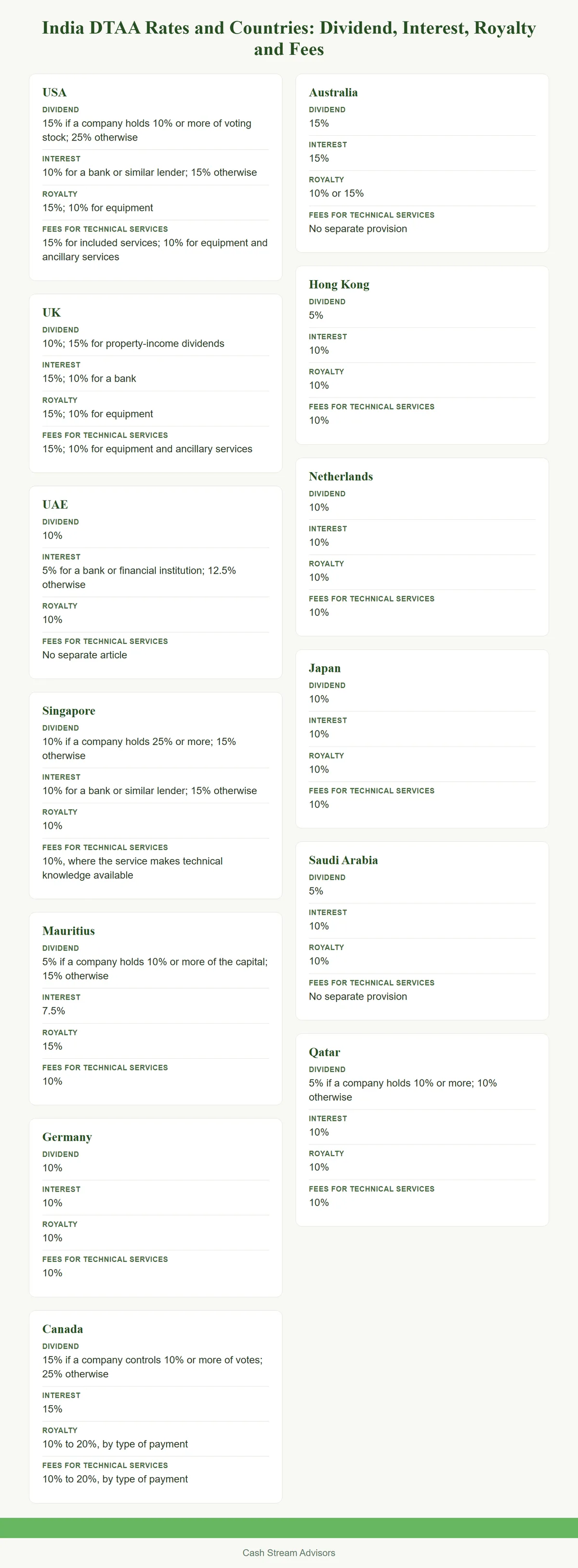
Caps only. Qatar is a new agreement notified in October 2025, and it applies to income arising on or after 1 April 2026. Read the treaty and the latest protocol before you rely on a figure. The Department chart does not carry article numbers, so they are shown in each country guide. For each country in detail, read India-USA DTAA: Treaty Rates, Forms and How to Claim Them, India-UK DTAA: Treaty Rates, Pensions and How to Claim Them, India-UAE DTAA: Treaty Rates, the Residency Catch and How to Claim, India-Singapore DTAA: Treaty Rates, Capital Gains and How to Claim, India-Mauritius DTAA: What the 2024 Protocol and PPT Change and India-Germany DTAA: Treaty Rates, PE Risk and How to Claim.
India DTAA countries list: which countries have a DTAA?
PwC's India tax summary counts 94 comprehensive agreements and 8 limited agreements. A comprehensive agreement covers most income. A limited agreement covers only specific income, such as shipping or air transport. The Income Tax Department publishes the notified list of DTAA countries, and that page is the one to check for the latest count. We do not paste the full list here, because new agreements and protocols change it.
What the rate does not cover
The table covers dividend, interest, royalty and fees. It does not cover capital gains or business profits, which follow other articles, and it does not test permanent establishment risk or treaty abuse. For those, read Royalty vs Fees for Technical Services Under a Treaty: The Make Available Test and Permanent Establishment Under a Tax Treaty: Test, Risk and Profit Attribution.
Capital gains differ by treaty. Under India-US, each country can generally tax the gain, and the residence country gives credit. For the other treaties we have read in detail, the position is below.
| Country | Shares of an Indian company | Other assets, such as mutual fund units |
|---|---|---|
| USA | Each country can tax; credit given | Each country can tax; credit given |
| UK | Each country may tax under its own law (Article 14) | Each country may tax under its own law (Article 14) |
| UAE | India may tax (Article 13(4)) | Taxable only in the country of residence (Article 13(5)); Tribunals have treated mutual fund units as other property |
| Singapore | India may tax shares acquired on or after 1 April 2017; earlier shares are grandfathered | Taxable only in Singapore, on the Tribunal view that mutual fund units are not shares |
| Mauritius | Before 1 April 2017: taxable only in Mauritius. From 1 April 2017 to 31 March 2019: India may tax at a reduced rate. Later: taxable in India | Check the treaty and the 2024 Protocol |
| Germany | India may tax (Article 13(4)) | Taxable only in the seller's country (Article 13(5)) |
Checked on 23 November 2026. For other corridors, read the capital gains article of the treaty. Gains on shares can also depend on the holding, the date of acquisition and anti-abuse tests.
How to claim the rate
Before the income is paid, give the payer your certificate of residence, Form 41 (old Form 10F), your PAN and a declaration. If too much was deducted, you claim it back through your return. For banks and NRO accounts, read TDS on NRO Interest and Dividends: How to Claim the Treaty Rate.
When to ask an adviser
Speak to us where the condition for a lower rate is unclear, the amount is large, or the officer has denied the rate. We read the treaty text, the protocol and your papers, and tell you what applies. Message us on WhatsApp.
Talk to an advisor
This Insights article is general information, not advice on a specific transaction. Read our disclaimer and regulatory compliance pages.
DTAA Advisory service
SERVICEWithholding Tax Advisory service
INSIGHTSWhat Is DTAA? How the Double Tax Avoidance Agreement Works in India
INSIGHTSIndia-USA DTAA: Treaty Rates, Forms and How to Claim Them
INSIGHTSIndia-UK DTAA: Treaty Rates, Pensions and How to Claim Them
INSIGHTSIndia-UAE DTAA: Treaty Rates, the Residency Catch and How to Claim
INSIGHTSNRI Rental Income From India and DTAA: How to Avoid Paying Tax Twice
INSIGHTSTDS on NRO Interest and Dividends: How to Claim the Treaty Rate
SERVICEAll insights
ABOUTAbout Cash Stream Advisors
CONTACTContact us
Official references
- Income Tax Department: tax rates, DTAA v. Income-tax Act
- Income Tax Department: DTAA guide and list of agreements
- Income Tax Department: Qatar, comprehensive agreement
- Income-tax Act 2025, Section 159: agreement with foreign countries and treaty relief
- PwC Worldwide Tax Summaries: India, foreign tax relief and tax treaties
DTAA Advisory
Treaty relief and TRC compliance for cross-border income., handled so it does not become the subject of your next article.