Moving to Dubai feels like the end of Indian tax. For many people it is not, because the India UAE DTAA gives relief only to a treaty resident, and living in the UAE is not the same thing. The catch sits in the residency article, and most of the mistakes we see start there.
The short answer
India and the UAE signed their tax treaty in 1992. This India UAE double taxation avoidance agreement can lower Indian tax on income of UAE residents, but only if you are a treaty resident with a UAE tax residency certificate, not just living in the UAE. In India you claim it with Form 41 (old Form 10F). For the papers, read Tax Residency Certificate (TRC) for DTAA: Who Issues It and What India Needs and Form 10F (Now Form 41): When You Need It and How to File It Online.
People look for it under several names: the UAE India DTAA, the UAE India tax treaty, or the DTAA between India and UAE. They all mean the same agreement.
Who this affects
- •
A UAE-based NRI with India income such as rent, interest or mutual fund gains.
- •
A founder or investor with a UAE company that earns from India or holds Indian shares.
- •
An Indian company paying a UAE vendor.
The residency catch
Living in a zero-tax country is not the same as being a treaty resident. Four points decide it.
- •
An individual is a UAE resident under the treaty if present in the UAE for at least 183 days in the calendar year (Article 4(1)(b)).
- •
A company must be incorporated in the UAE and managed and controlled wholly in the UAE (Article 4(1)(b)). A company that is incorporated there but run from elsewhere may not qualify.
- •
The certificate. The UAE Federal Tax Authority issues the tax residency certificate. It shows the UAE accepts you as its tax resident. It does not settle India's side.
- •
India's deemed-resident rule. An Indian citizen who is not liable to tax in any other country, and whose total income excluding foreign-source income is above 15 lakh rupees, is deemed a resident of India (Section 6(1A) of the 1961 Act, now Section 6(7) of the Income-tax Act 2025). A UAE-based citizen can then be a resident of both countries, which is a case of dual residency, not single residency. The treaty tie-breaker then applies in order: permanent home, centre of vital interests, habitual abode, and nationality (Article 4(3)). Nationality comes last, and for an Indian citizen it points to India. This is best handled with an adviser, year by year.
Example: an Indian citizen lives in Dubai for the full year with Indian rental income above the limit and no UAE tax. India treats him as a deemed resident, the UAE certificate says he is a UAE resident, and the tie-breaker decides which country is his treaty residence.
Rates at a glance
A treaty rate is a cap on India's tax, not the tax you pay. The payer deducts at the lower of the treaty and domestic rate, and surcharge and cess are not added to a treaty rate. For all countries side by side, read India DTAA Rates and Countries: Dividend, Interest, Royalty and Fees.
| Income | Treaty rate | Article | India domestic |
|---|---|---|---|
| Dividends | 10% | 10(2) | 20% before surcharge and cess; 10% in some cases |
| Interest | 5% for a bank or financial institution; 12.5% otherwise; exempt for a government or central bank | 11 | 20% before surcharge and cess |
| Royalties | 10% | 12(2) | 20% before surcharge and cess |
| Fees for technical services | No separate article. Treated under the business profits or other income articles | None | 20% before surcharge and cess |
| Business profits (PE) | Taxed in India only if there is a permanent establishment | 5 and 7 | Normal rates |
| Capital gains on shares and funds | Shares: India may tax. Other property such as mutual fund units: taxable only where the owner is resident | 13(4) and 13(5) | Under domestic law |
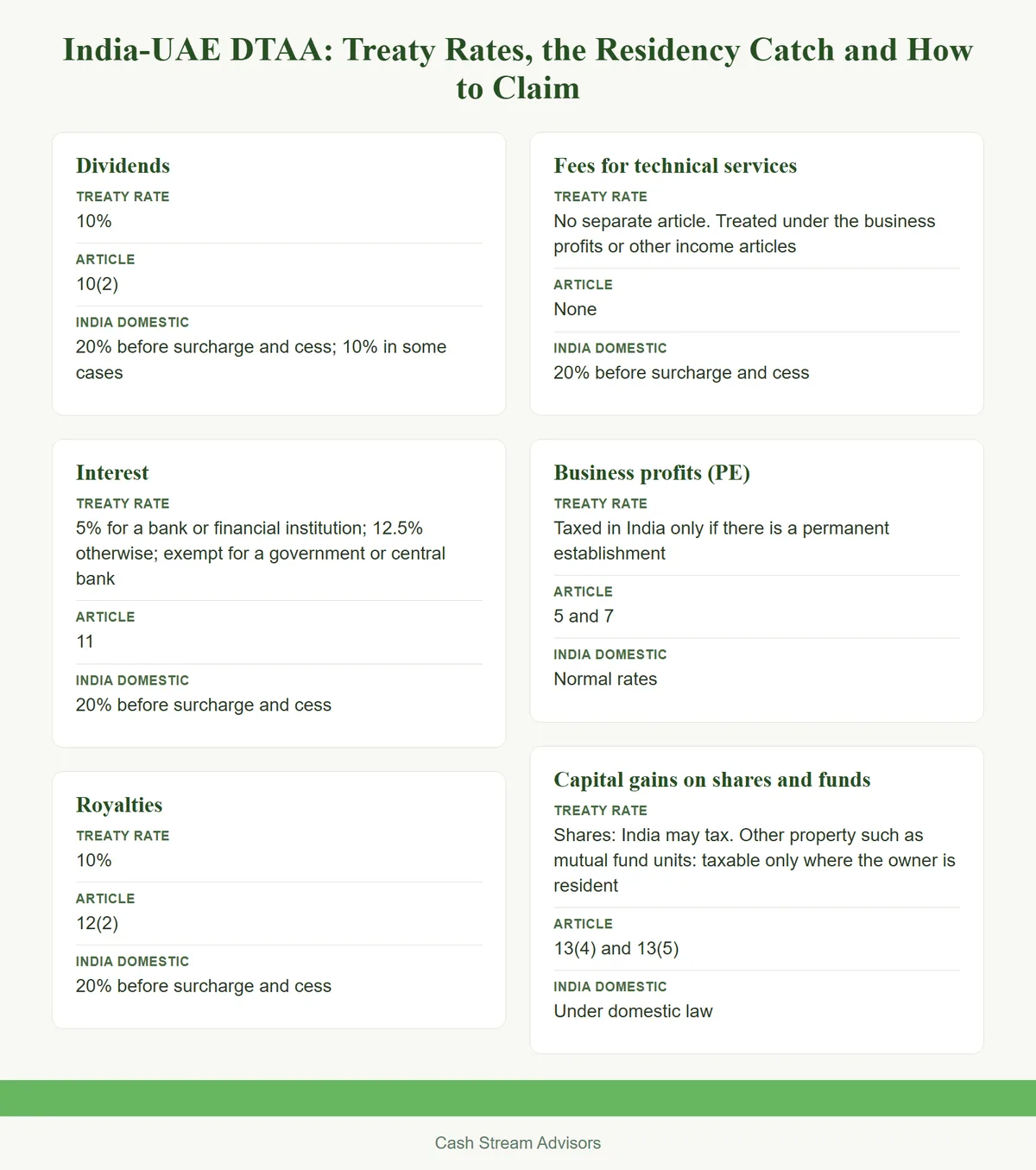
The treaty caps were checked against the treaty text on 23 November 2026. The domestic column follows the Income Tax Department's rate chart.
Capital gains on shares and mutual funds
Article 13 splits gains by type of asset:
- •
Immovable property. Taxable where the property is (13(1)). Shares of a company that mainly holds immovable property may be taxed where the property is (13(3)).
- •
Shares of an Indian company. India may tax the gain (13(4)).
- •
Everything else. Gains from any other property, including mutual fund units, are taxable only in the country where the owner is resident (13(5)).
Tribunals have read mutual fund units as "other property", not shares. In K.E. Faizal (Cochin Tribunal, 2019, 178 ITD 383), equity-oriented fund units were held outside Article 13(4) and within 13(5), so a UAE resident was not liable in India. In Saket Kanoi (Delhi Tribunal, October 2024, [2024] 168 taxmann.com 418), the Tribunal followed the same reading for mutual funds, and held that a UAE individual need not have paid UAE tax to claim the treaty, because it is enough that the UAE has the right to tax. These are Tribunal rulings, so the officer may take another view. For the wider planning questions, read the NRI tax pages on this site.
Example: a UAE-resident NRI sells Indian equity shares and Indian mutual fund units in the same year. The share gain may be taxed in India. The fund gain is taxable only in the UAE, which does not tax individuals, so it may be taxed nowhere.
How to claim from India
- 1
Get the UAE tax residency certificate from the Federal Tax Authority for the period of the claim.
- 2
File Form 41 (old Form 10F) on the Income Tax e-Filing portal. It is required even though the certificate has been issued.
- 3
Give the payer the papers before payment: the certificate, Form 41, your PAN or tax identification number, and a no-PE declaration if asked.
- 4
The payer applies the treaty rate before it deducts tax.
- 5
For an NRI account, the bank may ask for its own declaration alongside these papers.
Where a person has no tax identification number, a unique identification number such as the Emirates ID can be used.
PE and the principal purpose test
A fixed place of business in India can still create a PE. In Hyatt International Southwest Asia Ltd., the Delhi High Court held in December 2023 that a Dubai company had a fixed place PE in India under Article 5(1) of this treaty. On 24 July 2025 the Supreme Court affirmed it, because the company had continuous, substantive control over the hotels' operations under long-term agreements. Profits attributable to the PE are taxable in India even where the whole enterprise made a loss. The Court noted that there is no standard formula for every case, so each case turns on its facts.
The treaty has no limitation of benefits clause. A principal purpose test applies instead, from 1 April 2020 for Indian withholding taxes: a benefit can be denied where obtaining it was one of the principal purposes of an arrangement. The certificate alone does not guarantee the rate.
Where claims go wrong
Five common mistakes, with fixes:
- 1
Assuming living in the UAE is treaty residence. Fix: check the 183 days, or the incorporation and management of the company, before the claim.
- 2
No UAE certificate for the right period. Fix: match the period before the first payment.
- 3
Missing the dual-residency position of an Indian citizen. Fix: run the deemed-resident and tie-breaker test each year.
- 4
Using the wrong capital gains article. Fix: decide whether the asset is a share or other property first.
- 5
Ignoring PE risk when a UAE entity controls Indian operations. Fix: review control and presence before the payment.
Talk to us
If you are a UAE-based NRI or a founder with a UAE entity, and the residency, the asset or the papers are unclear, speak to us before the transaction. Message us on WhatsApp.
From our practice: timing a return from the UAE
Situation. A client planned to return to India permanently after 15 years in the UAE, with meaningful overseas investment income. Without planning around the return date, the client would have become a full resident earlier than necessary and lost the more favourable RNOR status sooner.
What we did. We reviewed the client's travel history and days in India over the preceding years, modelled how the exact return date would affect the RNOR window under the residency rules, and advised on the best date to relocate.
Result. The timing secured two additional years of RNOR status. An estimated ₹50 to 60 lakh of overseas investment income stayed outside Indian tax in that period, roughly ₹15 to 18 lakh of tax avoided or deferred. Details are anonymised, and every case depends on its own facts.
Talk to an advisor
This Insights article is general information, not advice on a specific transaction. Read our disclaimer and regulatory compliance pages.
DTAA Advisory service
SERVICEWithholding Tax Advisory service
INSIGHTSIndia-USA DTAA: Treaty Rates, Forms and How to Claim Them
INSIGHTSIndia DTAA Rates and Countries: Dividend, Interest, Royalty and Fees
INSIGHTSIndia-UK DTAA: Treaty Rates, Pensions and How to Claim Them
INSIGHTSTax Residency Certificate (TRC) for DTAA: Who Issues It and What India Needs
INSIGHTSForm 10F (Now Form 41): When You Need It and How to File It Online
SERVICEAll insights
ABOUTAbout Cash Stream Advisors
CONTACTContact us
Official references
- Income Tax Department: UAE, comprehensive agreement and protocols
- Income Tax Department: UAE, synthesised text with the MLI
- Income Tax Department: tax rates, DTAA v. Income-tax Act
- Income-tax Act 2025, Section 159: agreement with foreign countries and treaty relief
- Income-tax Rules 2026, Rule 75: documents for claiming relief under Section 159
- SCC Online: Supreme Court ruling on Hyatt International Southwest Asia (24 July 2025)
- EY: Supreme Court on fixed place PE, Hyatt International (July 2025)
DTAA Advisory
Treaty relief and TRC compliance for cross-border income., handled so it does not become the subject of your next article.