A UK pension that a returning Indian is unsure how to report. A flat in Chennai whose rent the owner in London is taxed on twice. A UK vendor whose invoice an Indian payer will not release without papers. All three come back to one document. So what does the India UK DTAA actually say, and what do you have to show before it helps you?
The short answer
India and the United Kingdom signed their tax treaty in 1993, and a 2013 protocol amended it. This India UK double taxation avoidance agreement caps the tax each country may charge on dividends, interest, royalties and fees, and gives credit for tax paid in the other. You claim it with a UK certificate of residence and, in India, Form 41 (old Form 10F). For the papers, read Tax Residency Certificate (TRC) for DTAA: Who Issues It and What India Needs and Form 10F (Now Form 41): When You Need It and How to File It Online.
People search for it under several names: the India UK tax treaty, the UK India double taxation treaty, or the DTAA between India and UK. They all mean the same convention.
Who this affects
- •
A UK-based NRI with India income such as rent, interest or dividends.
- •
A returning Indian with a UK pension or UK property, moving back to India.
- •
An Indian company paying a UK vendor for royalties, services or software.
Rates at a glance
A treaty rate is a cap on India's tax, not the tax you pay. The payer deducts at the lower of the treaty and domestic rate, and surcharge and cess are not added to a treaty rate. For all countries side by side, read India DTAA Rates and Countries: Dividend, Interest, Royalty and Fees.
| Income | Treaty rate | Article | India domestic |
|---|---|---|---|
| Dividends | 10%; 15% for property-income dividends | 11 | 20% before surcharge and cess; 10% in some cases |
| Interest | 15%; 10% where the lender is a bank carrying on a banking business | 12 | 20% before surcharge and cess |
| Royalties | 15%; 10% for the use of equipment | 13 | 20% before surcharge and cess |
| Fees for technical services | 15%; 10% where ancillary to leased equipment | 13 | 20% before surcharge and cess |
| Business profits (PE) | Taxed in India only if there is a permanent establishment | 5 and 7 | Normal rates |
| Capital gains | No cap. Each country may tax under its own law | 14 | Under domestic law |
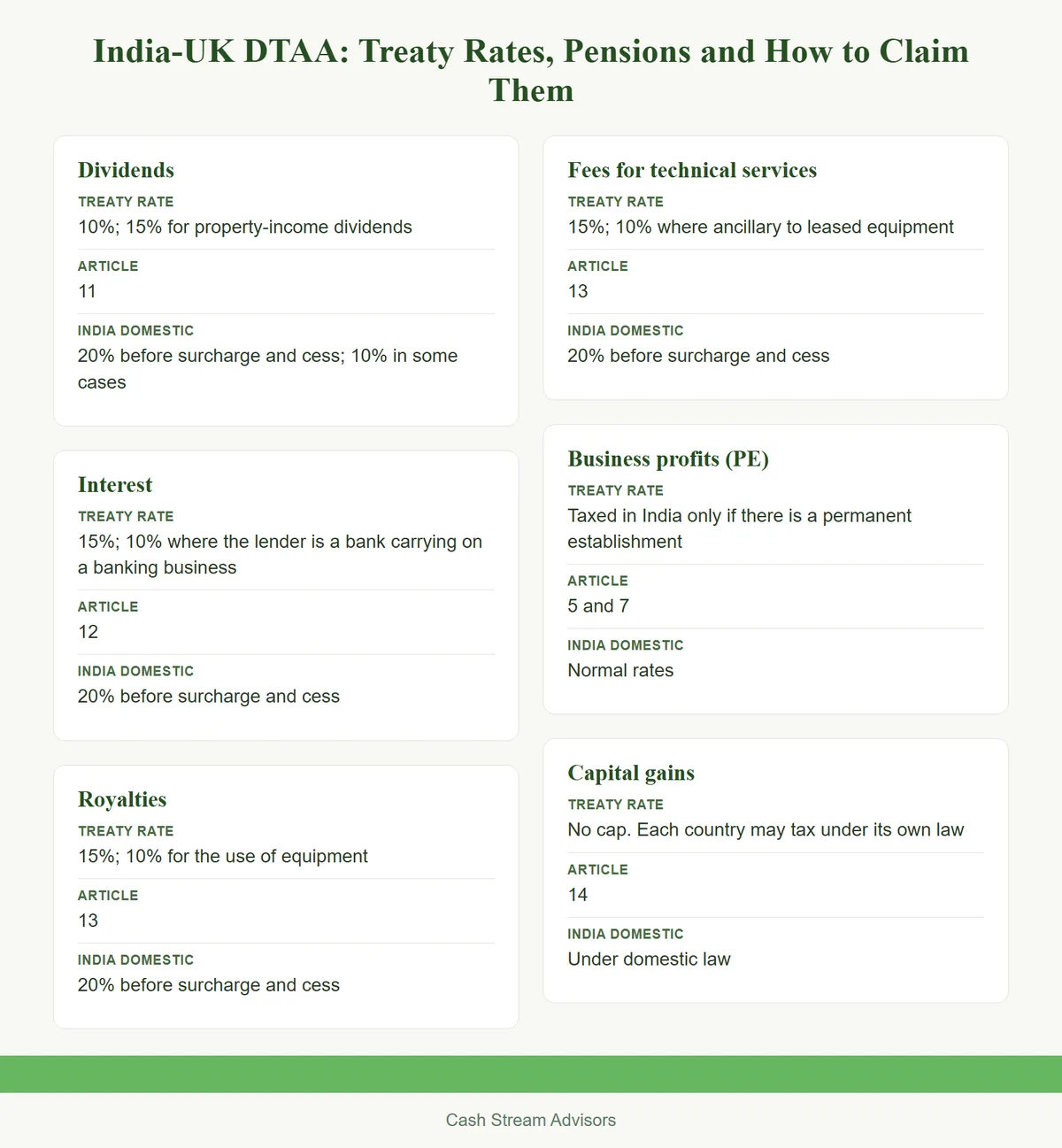
The treaty caps were checked against the amended treaty text on 23 November 2026, and the domestic column follows the Income Tax Department's rate chart. Interest paid to the UK government, a political subdivision or a UK local authority is exempt in India, as is certain interest on loans guaranteed or insured by UK Export Finance.
Pensions and rental income
The pension articles work in both directions.
- •
UK pension, person resident in India. A private pension or annuity is taxable only in India (Article 20(1)). A UK government service pension is taxable only in the UK (Article 19(2)). Example: a returning Indian who worked in the private sector draws a UK pension. India taxes it as a resident, and the UK should not tax it once treaty relief is claimed.
- •
Indian pension, person resident in the UK. A private pension or annuity is taxable only in the UK (Article 20(1)). An Indian government service pension is taxable only in India (Article 19(2)). Example: a UK resident draws a pension from a private Indian employer. It is taxed in the UK, not in India.
- •
Rental income from Indian property. India may tax it, because the property is there (Article 6(1)). A UK-resident owner is also taxed in the UK on worldwide income, and the UK gives credit for the Indian tax (Article 24). Example: a UK resident owns a flat in Chennai. India taxes the rent, and the UK credits that tax.
Article 20(2) treats payments under social security legislation as pensions, so a UK State Pension paid to a resident of India should fall under the same rule. The way a UK pension is reported in the UK, and any relief claim there, needs a UK adviser. For NRI rental income, read the NRI pages on this site.
How to claim from India
- 1
Get the HMRC certificate of residence for the period of the claim.
- 2
File Form 41 (old Form 10F) on the Income Tax e-Filing portal. It is required even though the certificate has been issued.
- 3
Give the payer the papers before payment: the certificate, Form 41, your PAN or tax identification number, and a no-PE declaration if asked.
- 4
The payer applies the treaty rate before it deducts tax.
- 5
For an NRI with an Indian bank, the bank may ask for its own declaration alongside these papers.
How to claim from the UK
We explain two things on the UK side: how the credit works and what the certificate of residence is. Under Article 24 of the treaty, Indian tax on income from Indian sources is allowed as a credit against UK tax on the same profits. The credit is limited to the UK tax on that income, so Indian tax does not erase UK tax. An Indian resident who needs relief in the UK first obtains a certificate of residence in India (Form 42, with the certificate issued in Form 43).
The UK self assessment return, including the foreign pages and the credit entries, should be prepared by a UK adviser. We do not prepare UK returns.
The MLI and the principal purpose test
The Multilateral Instrument modifies this treaty. A principal purpose test replaced the treaty's Article 28C. It applies to UK withholding taxes from 1 January 2020, and to Indian withholding taxes from 1 April 2020. A benefit can be denied where obtaining it was one of the principal purposes of an arrangement, unless granting it fits the object of the treaty. The certificate alone does not guarantee the rate.
Capital gains between India and the UK
Article 14 lets each country tax capital gains under its own law. So India may tax a gain on Indian property or shares, and the UK may tax the same gain on a UK resident, with credit given. The tax depends on the asset, the holding period and your residential status in India. Speak to us before you sell if the amount is large.
Where claims go wrong
Five common mistakes, with fixes:
- 1
Certificate does not cover the income year. Fix: match the period before the first payment.
- 2
No Form 41, or filed late. Fix: file it before the payment.
- 3
Using the 10% rate on the wrong payment. The lower rate is for equipment and ancillary services. Fix: check what the payment is for.
- 4
Treating a pension as taxable in both countries. Fix: read Articles 19 and 20 before the return is filed.
- 5
No UK credit claimed. Fix: keep the Indian tax certificate and give it to your UK adviser.
Talk to us
If you are a UK-linked NRI, a returning resident or a payer, and the income type or the papers are unclear, speak to us before the payment. Message us on WhatsApp.
Talk to an advisor
This Insights article is general information, not advice on a specific transaction. Read our disclaimer and regulatory compliance pages.
DTAA Advisory service
SERVICEWithholding Tax Advisory service
INSIGHTSIndia-USA DTAA: Treaty Rates, Forms and How to Claim Them
INSIGHTSIndia DTAA Rates and Countries: Dividend, Interest, Royalty and Fees
INSIGHTSNRI Rental Income From India and DTAA: How to Avoid Paying Tax Twice
INSIGHTSTDS on NRO Interest and Dividends: How to Claim the Treaty Rate
INSIGHTSForeign Tax Credit in India: Form 67, Form 44 and US Form 1116 Explained
SERVICEAll insights
ABOUTAbout Cash Stream Advisors
CONTACTContact us
Official references
- Income Tax Department: UK, comprehensive agreement
- Income Tax Department: UK, synthesised text with the MLI
- GOV.UK: India tax treaties (1993 convention, 2013 protocol and 2020 synthesised text)
- GOV.UK: UK-India synthesised text of the MLI and the 1993 convention
- HMRC Double Taxation Relief Manual, DT9552: India treaty summary
- Income Tax Department: tax rates, DTAA v. Income-tax Act
- Income-tax Act 2025, Section 159: agreement with foreign countries and treaty relief
- Income-tax Rules 2026, Rule 75: documents for claiming relief under Section 159
DTAA Advisory
Treaty relief and TRC compliance for cross-border income., handled so it does not become the subject of your next article.