A flat in Chennai, a landlord in New Jersey, and a tenant who has just been told to deduct tax before paying the rent. Most NRI landlords ask the same thing at this point: surely the tax treaty fixes this? It does not, and knowing why saves a lot of confusion. This guide covers NRI rental income tax in India, and what the DTAA really does for it.
The short answer
India taxes rent from Indian property whichever country the owner lives in. The tenant must deduct TDS at the rate in force for a non-resident, and no treaty lowers that rate. The treaty only decides the credit you get at home. A lower-deduction certificate, applied for before the year starts, can reduce the deduction. For the papers a treaty claim needs on other income, read Tax Residency Certificate (TRC) for DTAA: Who Issues It and What India Needs and Form 10F (Now Form 41): When You Need It and How to File It Online.
Who this affects
- •
An NRI landlord in the US, UK, UAE, Singapore, Canada or Australia with a house or flat let out in India.
- •
A family or tenant in India paying rent to an NRI, who must deduct the tax.
- •
A returning NRI who still has rent from India and is moving between tax statuses.
What the tenant deducts and why
The tenant must deduct tax on rent paid to an NRI under Section 393(2) of the Income-tax Act 2025 (old Section 195), from the first rupee, with no monthly limit. The rate is the rate in force for a non-resident individual: 30% plus surcharge, where it applies, and 4% cess. That is 31.2% before any surcharge. Because a tenant often does not know the landlord's total income, many tenants and banks deduct at the maximum rate with surcharge, which can go to around 38% or more, and the landlord claims the difference back. If the landlord has no PAN, a higher rate can apply, so give the tenant your PAN.
This is the point on which NRI rental income tax usually surprises people: the deduction is on gross rent, but your tax is on net rent. You can deduct 30% of the rent as a standard deduction (old Section 24(a)) and municipal taxes paid, and a loan interest deduction in some cases. The gap is claimed back as a refund in your return. For the refund timeline, see our NRI TDS refund guides.
Illustration (hypothetical, round numbers): rent of ₹1 lakh a month is ₹12 lakh a year. At 31.2%, the tenant deducts about ₹3.74 lakh. After the 30% deduction, the taxable rent is ₹8.4 lakh, and the tax due on it can be much lower than the TDS. The difference comes back as a refund when the return is filed.
The tenant's steps:
- 1
Get a TAN, which is needed for deducting tax on an NRI payment.
- 2
Deduct and deposit the tax on each payment.
- 3
File the quarterly statement of deduction for payments to non-residents, which is Form 144 under the Income-tax Rules 2026 (old Form 27Q).
- 4
Give the landlord the TDS certificate.
Readers also search for this as TDS on rent paid to NRI, TDS on rent to NRI, tax on rental income for NRI or NRI rental income TDS. The answer is the same: Section 393(2) applies from the first rupee, and the tenant, not the landlord, is responsible for deducting.
Does the DTAA reduce the TDS on rent?
No. The property article (Article 6 in the US, UK, UAE, Singapore and Australia treaties) gives the taxing right to the country where the property is situated, with no cap on its rate. India can therefore tax the rent in full, and a residence certificate and Form 41 do not lower the deduction.
What the treaty changes is the second step. Your home country may also tax the rent, but it gives credit for the Indian tax. That credit is what avoids double tax. For how the credit works, read Foreign Tax Credit in India: Form 67, Form 44 and US Form 1116 Explained. The country pages cover the US and the UK: India-USA DTAA: Treaty Rates, Forms and How to Claim Them and India-UK DTAA: Treaty Rates, Pensions and How to Claim Them.
The same question comes up as NRI rental income DTAA: people expect a treaty rate on rent as there is on dividends and interest. The answer for rent is no rate cap, only credit at home.
Lower-deduction certificate (Form 128)
A lower-deduction certificate lets the tenant deduct at a lower rate, or nil, because your actual tax is lower than the standard deduction rate. It is applied for under Section 395 on Form 128, on the TRACES portal, with a computation of your estimated income and tax. A PAN is required. The Department says an application cannot be processed once the transaction is complete, so apply before the rent is paid. In our practice we apply about three months before the year starts, so the certificate is ready for the first rent.
Where you get credit at home
| Country | Home treatment | Form | Note |
|---|---|---|---|
| United States | Credit for Indian tax | Form 1116 and Schedule E | Rent is usually in the passive category |
| United Kingdom | Credit | SA106 (foreign pages of self assessment) | Capped at UK tax on the income |
| Canada | Credit | Form T2209 | Capped at Canadian tax on that income |
| Australia | Offset | Foreign income tax offset on the ATO return | Non-refundable |
| UAE | No personal income tax | None | Indian tax is the only tax |
| Singapore | Domestic exemption for most foreign income of individuals | None | Not a treaty claim |
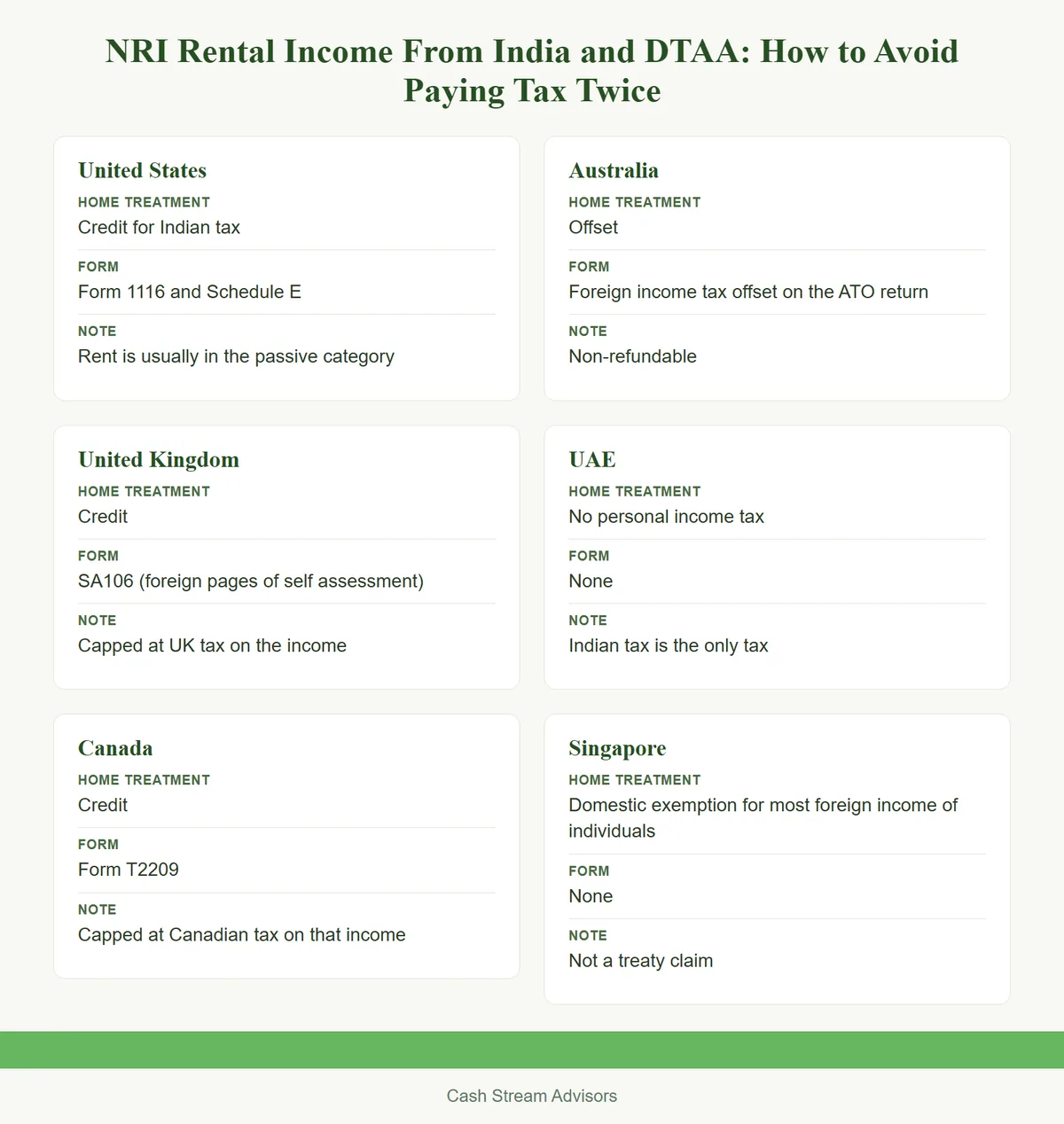
Home-country rules and rates change, so confirm with an adviser there.
Where claims go wrong
- 1
No Indian return filed. Fix: file, to claim the refund and to support credit abroad.
- 2
No TDS certificate. Fix: ask the tenant for it each quarter.
- 3
Treating the residence certificate as a once-only paper. Fix: renew it each year.
- 4
Tenant deducting at the wrong rate. Fix: give the tenant a written rate, or a lower-deduction certificate, before the first payment.
- 5
No credit claimed at home. Fix: use the foreign tax credit form for the year.
Illustration (hypothetical, not a client matter): an NRI landlord lets a flat to a family. The tenant deducts the full rate and the landlord never files a return, because "TDS is already paid". He loses the refund of the excess, and his home-country credit is hard to support without the Indian return.
A short note for tenants
A tenant is the person who must deduct. If you pay rent to an NRI, agree the rate with the landlord in writing, hold a TAN and keep the certificate.
Talk to us
If you are an NRI landlord, speak to us before the next rent payment falls due. Message us on WhatsApp.
Talk to an advisor
This Insights article is general information, not advice on a specific transaction. Read our disclaimer and regulatory compliance pages.
DTAA Advisory service
SERVICENRI Tax and Relocation Advisory
INSIGHTSWhat Is DTAA? How the Double Tax Avoidance Agreement Works in India
INSIGHTSIndia-USA DTAA: Treaty Rates, Forms and How to Claim Them
INSIGHTSIndia-UK DTAA: Treaty Rates, Pensions and How to Claim Them
INSIGHTSForeign Tax Credit in India: Form 67, Form 44 and US Form 1116 Explained
INSIGHTSTDS on NRO Interest and Dividends: How to Claim the Treaty Rate
SERVICEAll insights
ABOUTAbout Cash Stream Advisors
CONTACTContact us
Official references
DTAA Advisory
Treaty relief and TRC compliance for cross-border income., handled so it does not become the subject of your next article.