A finance head in Pune is about to pay a US firm for a market study, a software licence and a week of staff training, all on one invoice. Three payments, three possible tax treatments, and one TDS decision to make before the money leaves. Everything turns on one question: what exactly is being paid for? This guide explains how to classify the payment, and how the make available test works.
The short answer
Whether a foreign vendor's fee is taxable in India depends on the treaty, not just the label. Some treaties, including the US, UK and Singapore, tax technical fees only if the service makes technical knowledge available, a test Indian domestic law does not have. The payer needs a tax residency certificate and Form 41 to rely on it. See Tax Residency Certificate (TRC) for DTAA: Who Issues It and What India Needs and Form 10F (Now Form 41): When You Need It and How to File It Online.
Who this is for
- •
A finance head paying a foreign vendor for software, services or a licence.
- •
A foreign group billing an Indian company.
- •
A CA firm reviewing a withholding position.
Royalty, fees for technical services or business profits
Start with what the payment is. The same vendor can bill three kinds of payment, and each is taxed differently at source. Business profits are taxed in India only where the vendor has a permanent establishment here, which is covered in the permanent establishment guides.
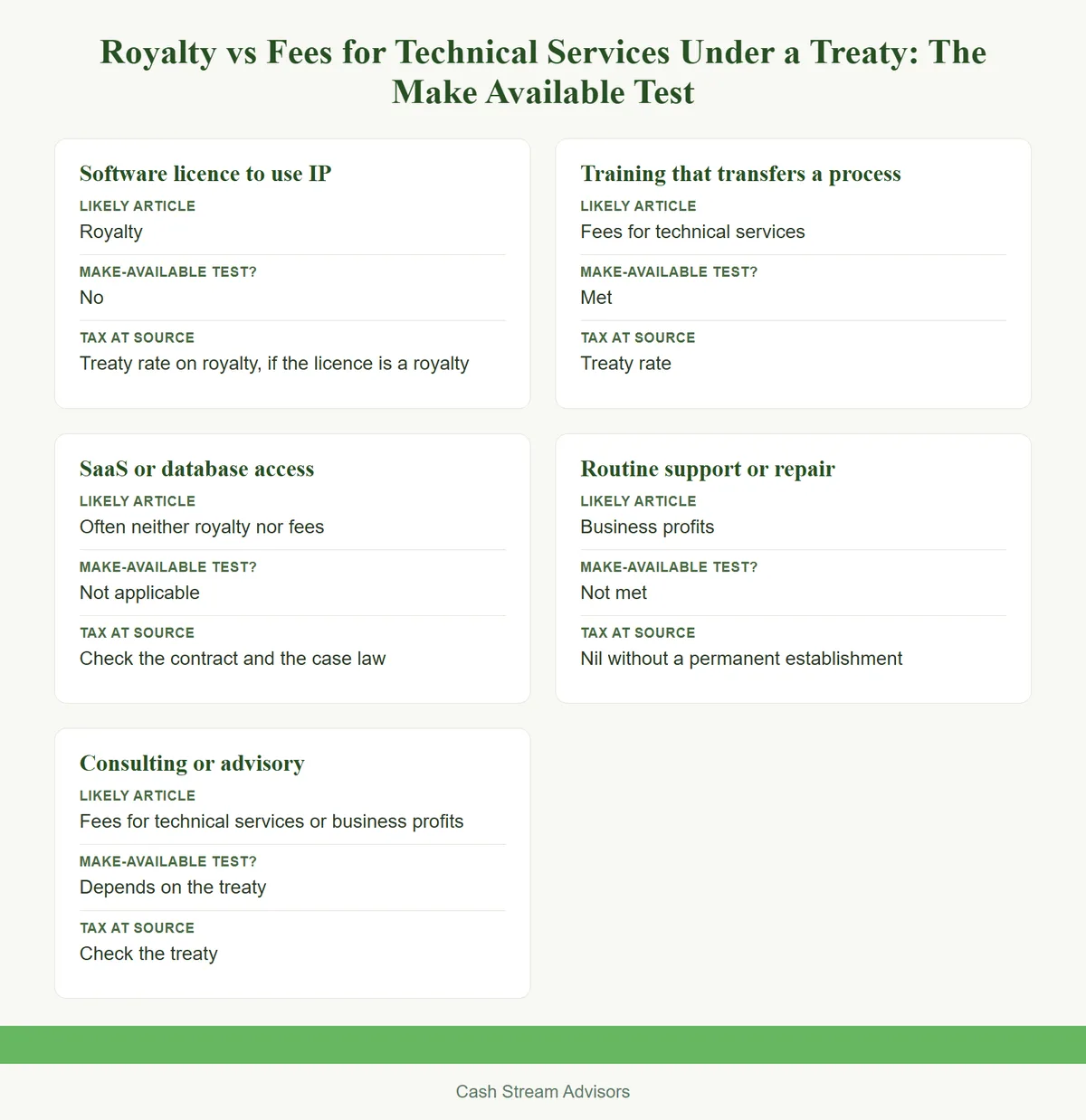
| Payment | Likely article | Make-available test? | Tax at source |
|---|---|---|---|
| Software licence to use IP | Royalty | No | Treaty rate on royalty, if the licence is a royalty |
| SaaS or database access | Often neither royalty nor fees | Not applicable | Check the contract and the case law |
| Consulting or advisory | Fees for technical services or business profits | Depends on the treaty | Check the treaty |
| Training that transfers a process | Fees for technical services | Met | Treaty rate |
| Routine support or repair | Business profits | Not met | Nil without a permanent establishment |
The domestic rate on royalty and on fees for technical services paid to a non-resident is 20% before surcharge and cess, and the treaty rate is the cap where it is lower. This is the answer to most searches for TDS on royalty section or TDS on fees for technical services: the payer deducts under Section 393(2) of the Income-tax Act 2025 (old Section 195) at the lower of the domestic and treaty rate, with the right papers. Payments to a resident follow Section 393(1) (old Section 194J), which has its own rates and is not covered here.
The make available test
What is make available clause in DTAA? The test asks whether the service makes technical knowledge, skill or know-how available to the buyer, so the buyer can apply it on its own later. In plain terms, it means transferring the knowledge so thoroughly that the same work can be done without the original provider's help.
A one-off repair, an audit or advice that delivers a result does not pass. The buyer gets the output, not the ability to produce it. Training that leaves the buyer able to do the work does pass.
Domestic law has no such test. The Act's definition of fees for technical services covers managerial, technical and consultancy services as such. A payer relying on the treaty has to show the service falls outside the treaty article. For the basics, read What Is DTAA? How the Double Tax Avoidance Agreement Works in India.
Illustration (hypothetical, not a client matter): an Indian company hires a US firm for a one-time market study. The firm sends a report. The Indian company cannot repeat the study without the US firm. The service does not make the technical knowledge available. If the treaty has the test, the fee may not be taxed in India as technical fees. If the same US firm trains the Indian team to run the study itself, the test may be met.
Which treaties carry the clause
| Treaty | Article | Clause present? | FTS rate |
|---|---|---|---|
| United States | 12 | Yes: fees for included services that make technical knowledge, skill, know-how or processes available | 15% (10% in some cases) |
| United Kingdom | 13(4)(c) | Yes, alongside services ancillary to a royalty or to property enjoyment | 15% (10% in some cases) |
| Singapore | 12 | Yes: the 10% rate applies to services that make technical knowledge available | 10% |
| Germany | 12 | No: Article 12 covers managerial, technical and consultancy services | 10% |
Other treaties differ, and a protocol or most-favoured-nation clause can add or remove the clause. The rates are caps, checked on 23 November 2026. Read the article of the treaty with the payee's country before you rely on it, starting with India-USA DTAA: Treaty Rates, Forms and How to Claim Them, India-Singapore DTAA and India-Germany DTAA.
Software and SaaS payments
A software licence and a subscription are not the same. A licence gives a right to use copyright. A subscription gives access to an application hosted by the vendor.
- •
Engineering Analysis (Supreme Court, 2 March 2021). Payments under end-user licence and distribution agreements for software were held not to be royalty for the use of copyright under the treaties, so there was no duty to deduct tax under Section 195. The Court also found the Act's provisions on royalty did not help the Revenue on those facts. Reported at (2021) 432 ITR 471.
- •
Salesforce.com Singapore (Delhi High Court, 2024). Subscription fees for access to a customer relationship application were held not assessable in India, because the copyright was not transferred and the customer only had access. The Supreme Court dismissed the Revenue's appeal in 2025. A dismissal of an appeal is not the same as a ruling on the law, so the position is helpful but not final. Reported at (2024) 465 ITR 257 and (2025) 479 ITR 219.
What the payer should hold: the contract, a description of what the customer receives, the vendor's residence certificate, Form 41 and a no-PE declaration.
What the payer must collect and file
- 1
Vendor's tax residency certificate and Form 41 (old Form 10F).
- 2
No-PE and beneficial-ownership declarations.
- 3
The contract, showing what is being delivered.
- 4
Form 145 (old Form 15CA) for the remittance, and Form 146 (old Form 15CB), the Chartered Accountant's certificate, where the taxable payment is more than ₹5 lakh in a year.
- 5
Deduct at the right rate: 20% before surcharge and cess on these payments, or the lower treaty rate.
If the position is challenged later, the payer is in default for the shortfall, with interest, and may be denied the deduction for the expense. The papers above are the defence.
Where positions go wrong
- 1
Deducting at the treaty rate on everything. Fix: classify the payment first.
- 2
Treating SaaS as royalty. Fix: read the contract and the case law.
- 3
No Form 41. Fix: file it before the payment.
- 4
Ignoring permanent establishment. Fix: check the vendor's presence in India.
- 5
Contract wording that invites technical-fee treatment. Fix: describe the service accurately, and do not call a one-off advisory "training" or "transfer of know-how".
Illustration (hypothetical, not a client matter): an Indian manufacturer pays its German technology partner for a licence to use a patented process and deducts tax at the domestic rate for fear of getting it wrong. After reading the treaty, the payer applies the treaty rate of 10% on royalty, with the residence certificate and Form 41 in place, and sets up a process for later payments.
Talk to us
If you have a foreign payment under review, speak to us before the payment. Message us on WhatsApp or use our contact page.
Talk to an advisor
This Insights article is general information, not advice on a specific transaction. Read our disclaimer and regulatory compliance pages.
DTAA Advisory service
SERVICEWithholding Tax Advisory service
INSIGHTSPermanent Establishment Under a Tax Treaty: Test, Risk and Profit Attribution
INSIGHTSWhat Is DTAA? How the Double Tax Avoidance Agreement Works in India
INSIGHTSTax Residency Certificate (TRC) for DTAA: Who Issues It and What India Needs
INSIGHTSForm 10F (Now Form 41): When You Need It and How to File It Online
INSIGHTSIndia-USA DTAA: Treaty Rates, Forms and How to Claim Them
INSIGHTSIndia-Germany DTAA: Treaty Rates, PE Risk and How to Claim
SERVICEAll insights
ABOUTAbout Cash Stream Advisors
CONTACTContact us
Official references
- Income-tax Act 2025, Section 159: agreement with foreign countries and treaty relief
- Income-tax Act 2025, Section 393: tax deducted at source
- Income Tax Department: Form 41 FAQs
- IRS: India tax treaty documents
- GOV.UK: India tax treaties (1993 convention, 2013 protocol and 2020 synthesised text)
- Income Tax Department: Germany, comprehensive agreement
- Income Tax Department: Singapore, comprehensive agreement and protocols
- Khaitan & Co: Engineering Analysis Centre of Excellence v. CIT, Supreme Court (2021)
- CIT v. Salesforce.com Singapore Pte. Ltd., (2025) 479 ITR 219 (Supreme Court), digest
DTAA Advisory
Treaty relief and TRC compliance for cross-border income., handled so it does not become the subject of your next article.