Singapore has long been the default base for investors and service companies dealing with India. The treaty rates are among the more favourable ones. But the capital gains rules changed in 2017, and a Singapore address on its own does not prove treaty residence. This guide covers what the India Singapore DTAA gives, and what you must show to get it.
The short answer
India and Singapore signed their tax treaty in 1994, and it was last amended by a protocol effective 1 April 2017. The DTAA between India and Singapore caps tax on dividends, interest and royalties. Since the 2017 change, gains on Indian shares bought on or after 1 April 2017 may be taxed in India. To claim it, you need a Singapore certificate of residence and Form 41. For the papers, read Tax Residency Certificate (TRC) for DTAA: Who Issues It and What India Needs and Form 10F (Now Form 41): When You Need It and How to File It Online.
Who this affects
- •
A Singapore-based NRI with Indian shares, mutual funds, rent or interest.
- •
A Singapore company earning dividends, interest, royalties or fees from India.
- •
An Indian company paying a Singapore vendor, parent or lender.
Rates at a glance
A treaty rate caps India's tax. The payer deducts at the lower of the treaty and domestic rate, and surcharge and cess are not added to a treaty rate. For all countries side by side, read India DTAA Rates and Countries: Dividend, Interest, Royalty and Fees.
| Income | Treaty rate | Article | Checked |
|---|---|---|---|
| Dividends | 10% if the company holds 25% or more; 15% otherwise | 10 | 23 Nov 2026 |
| Interest | 10% for a bank or similar institution; 15% otherwise | 11 | 23 Nov 2026 |
| Royalties | 10% | 12 | 23 Nov 2026 |
| Fees for technical services | 10%, where the service makes technical knowledge available | 12 | 23 Nov 2026 |
| Business profits | Taxed in India only through a permanent establishment. A service PE can arise after more than 90 days in a fiscal year | 5 and 7 | 23 Nov 2026 |
| Capital gains | See the next section | 13 | 23 Nov 2026 |
Capital gains: the 2017 change
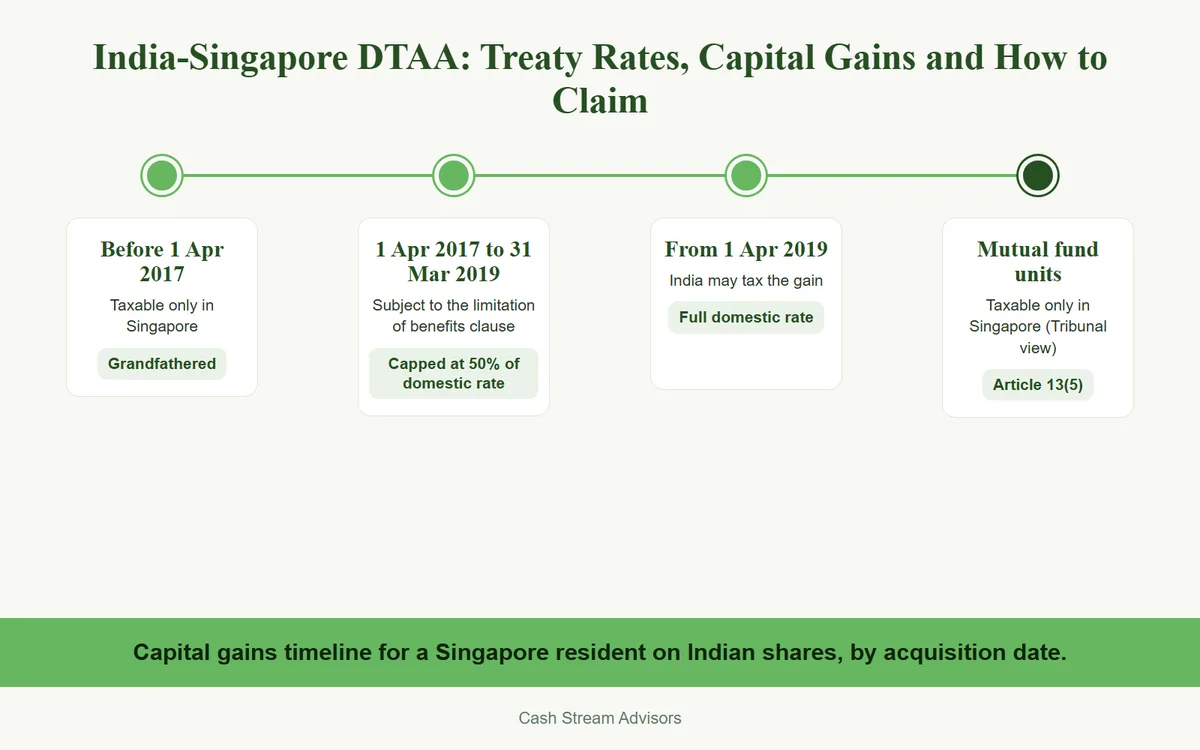
The Third Protocol, signed in 2016 and effective from 1 April 2017, changed how gains on Indian shares are taxed. In short:
- •
Shares acquired before 1 April 2017. Grandfathered. The gain is taxable only in Singapore, the seller's country of residence.
- •
Shares acquired from 1 April 2017 to 31 March 2019. India may tax the gain, at a rate not above 50% of its domestic rate, subject to the limitation of benefits clause.
- •
Shares acquired on or after 1 April 2019. India may tax the gain at its full domestic rate.
- •
Mutual fund units. Units are not shares. Tribunals have held that gains on them fall under Article 13(5), which gives the right to tax only to the country where the seller is resident. In Anushaka Sanjay Shah v. ITO (IT) (Mumbai Tribunal, March 2025, (2025) 173 taxmann.com 570), a Singapore-resident NRI's mutual fund gain was held taxable only in Singapore. This is a Tribunal view, not a High Court ruling, so the officer may take another position.
Example: a Singapore-resident NRI holds Indian equity shares bought in 2015 and units of an equity mutual fund bought in 2023. The 2015 shares are grandfathered and the fund gain is, on the Tribunal's reading, taxable only in Singapore. A share bought in 2021 would be taxable in India.
| Shares / units | Tax treatment | Note |
|---|---|---|
| Before 1 Apr 2017 | Grandfathered | Taxable only in Singapore |
| 1 Apr 2017 to 31 Mar 2019 | Capped at 50% of domestic rate | Subject to the limitation of benefits clause |
| From 1 Apr 2019 | Full domestic rate | India may tax the gain |
| Mutual fund units | Article 13(5) | Taxable only in Singapore (Tribunal view) |
How to claim from India
- 1
Get the Singapore Certificate of Residence from IRAS.
- 2
File Form 41 (old Form 10F) on the Income Tax e-Filing portal. It is required even though the certificate has been issued.
- 3
Give the payer the papers before payment.
- 4
The payer applies the treaty rate before deducting tax.
- 5
Keep the substance file in case an officer asks.
The IRAS Certificate of Residence
- •
Who can apply. A Singapore tax-resident company. IRAS excludes nominee companies and Singapore branches of foreign companies.
- •
How. Online on the myTax Portal. A person acting for the company needs Corppass authorisation for "Corporate Tax (Filing and Applications)", as a Preparer or an Approver.
- •
Time. IRAS says online applications are processed within seven working days.
- •
Period. The current calendar year and up to four back years. One advance year can be requested from October to December.
- •
The test. A certificate for a calendar year is issued if control and management of the business has been or will be exercised in Singapore for the whole of that year.
- •
Individuals. IRAS also has a separate route for individuals, so follow the IRAS page for individuals when you apply.
Limitation of benefits and the principal purpose test
Article 24A denies the capital gains concession to a shell or conduit company. IRAS describes that as a company with negligible or nil business operations and negligible or nil assets in Singapore. It is not treated as a shell if its expenditure on operations in Singapore was at least S$200,000 in the 24 months before the gain arose, tested again at the time of the claim. Other exceptions exist, so read the article before you rely on the test.
India has also applied a principal purpose test to this treaty through the Multilateral Instrument. A benefit can be denied where obtaining it was one of the principal purposes of an arrangement. A certificate alone does not close the question.
Fees for technical services
India-Singapore treaty relief can apply to fees for technical services at 10%, instead of the 20% a payer may deduct by default. The 10% rate applies to services that make technical knowledge, experience, skill, know-how or processes available to the payer. Treaty relief depends on the Singapore company's residence, the nature of the services and the papers. Where a payer deducts at the domestic rate by mistake, the correction is easier before payment than through a refund claim.
Where claims go wrong
- 1
Applying the treaty without the Singapore certificate. Fix: hold the certificate for the right period before the first payment.
- 2
Treating pre- and post-2017 shares the same. Fix: list the acquisition date of every lot.
- 3
No Form 41, or one with errors. Fix: file it before the payment and check the details. An error can surface only at assessment.
- 4
A Singapore company with no substance. Fix: keep proof of office, staff and spending; the limitation of benefits test looks at them.
- 5
Calling a mutual fund gain exempt without papers. Fix: keep the certificate and Form 41, and expect the officer to test the claim.
What the payer should hold
Form 41; the Singapore Certificate of Residence; a no-PE certificate; substance evidence (office, staff, expenditure); and proof of qualification under the limitation of benefits clause where it applies.
Talk to us
If you are a Singapore-based NRI or run a Singapore company with income from India, talk to us before the transaction. Message us on WhatsApp.
From our practice: fees for technical services at the treaty rate
Situation. A Singapore company provided technical services worth about ₹50 lakh to an Indian client. The Indian payer deducted tax at the domestic rate of over 20%, about ₹10 lakh, unaware that the India-Singapore DTAA caps the rate lower.
What we did. We reviewed the services against the treaty article on fees for technical services and confirmed that the lower rate applied. We helped the company obtain its Singapore certificate and file Form 41 (old Form 10F), and worked with the payer to correct the rate on the remaining and future payments.
Result. The rate came down from over 20% to the treaty rate of 10%, so ₹5 lakh was withheld instead of ₹10 lakh. The company avoided a refund claim and now keeps its treaty papers ready for future India income. Details are anonymised, and every case depends on its own facts.
Talk to an advisor
This Insights article is general information, not advice on a specific transaction. Read our disclaimer and regulatory compliance pages.
DTAA Advisory service
INSIGHTSTax Residency Certificate (TRC) for DTAA: Who Issues It and What India Needs
INSIGHTSForm 10F (Now Form 41): When You Need It and How to File It Online
INSIGHTSIndia DTAA Rates and Countries: Dividend, Interest, Royalty and Fees
INSIGHTSRoyalty vs Fees for Technical Services Under a Treaty: The Make Available Test
INSIGHTSPermanent Establishment Under a Tax Treaty: Test, Risk and Profit Attribution
SERVICEAll insights
ABOUTAbout Cash Stream Advisors
CONTACTContact us
Official references
- Income Tax Department: Singapore, comprehensive agreement and protocols
- Income Tax Department: Singapore, synthesised text
- IRAS: Singapore and India sign new protocol to update the DTA (2016)
- IRAS: Tax agreements with India and Uruguay enter into force
- IRAS: Apply for Certificate of Residence
- Anushaka Sanjay Shah v. ITO (IT), (2025) 173 taxmann.com 570 (Mumbai Tribunal), digest
- Income-tax Act 2025, Section 159: agreement with foreign countries and treaty relief
- Income-tax Rules 2026, Rule 75: documents for claiming relief under Section 159
DTAA Advisory
Treaty relief and TRC compliance for cross-border income., handled so it does not become the subject of your next article.