A German engineering firm sends two people to Pune for a commissioning job that was meant to take six weeks. Months later, the Indian customer asks for a no-PE certificate before paying the final invoice. The question behind it is simple: has the firm, without meaning to, set up a permanent establishment in India? This guide explains the permanent establishment test, the risk, and how profit is attributed.
The short answer
A permanent establishment is a fixed place, a dependent agent, a service team or a long project through which a foreign company does business in India. Under a treaty, India can tax the company's business profits only to the extent they are attributable to it. Without one, India generally cannot tax those profits. For the treaty basics, read What Is DTAA? How the Double Tax Avoidance Agreement Works in India.
Who this affects
- •
A foreign group with staff, an agent or a project in India.
- •
An Indian company hosting a foreign team or contracting with a foreign vendor.
- •
A CA firm reviewing an exposure.
The PE tests and the usual thresholds
There are five ways a PE arises. The permanent establishment test and its threshold depend on the treaty.
| Type | Test | Usual threshold |
|---|---|---|
| Fixed place | A place at the enterprise's disposal, through which business is carried on | No fixed time limit in most treaties; the facts decide |
| Dependent agent | A person who habitually concludes contracts, or secures orders | Facts |
| Service PE | Services through employees or other personnel | Days in a period, by treaty |
| Construction or installation | A site or project beyond the treaty period | By treaty, for example six months in Germany and the UK |
| Preparatory or auxiliary | Excluded if genuinely only preparatory | Watch for fragmenting one business into small parts |
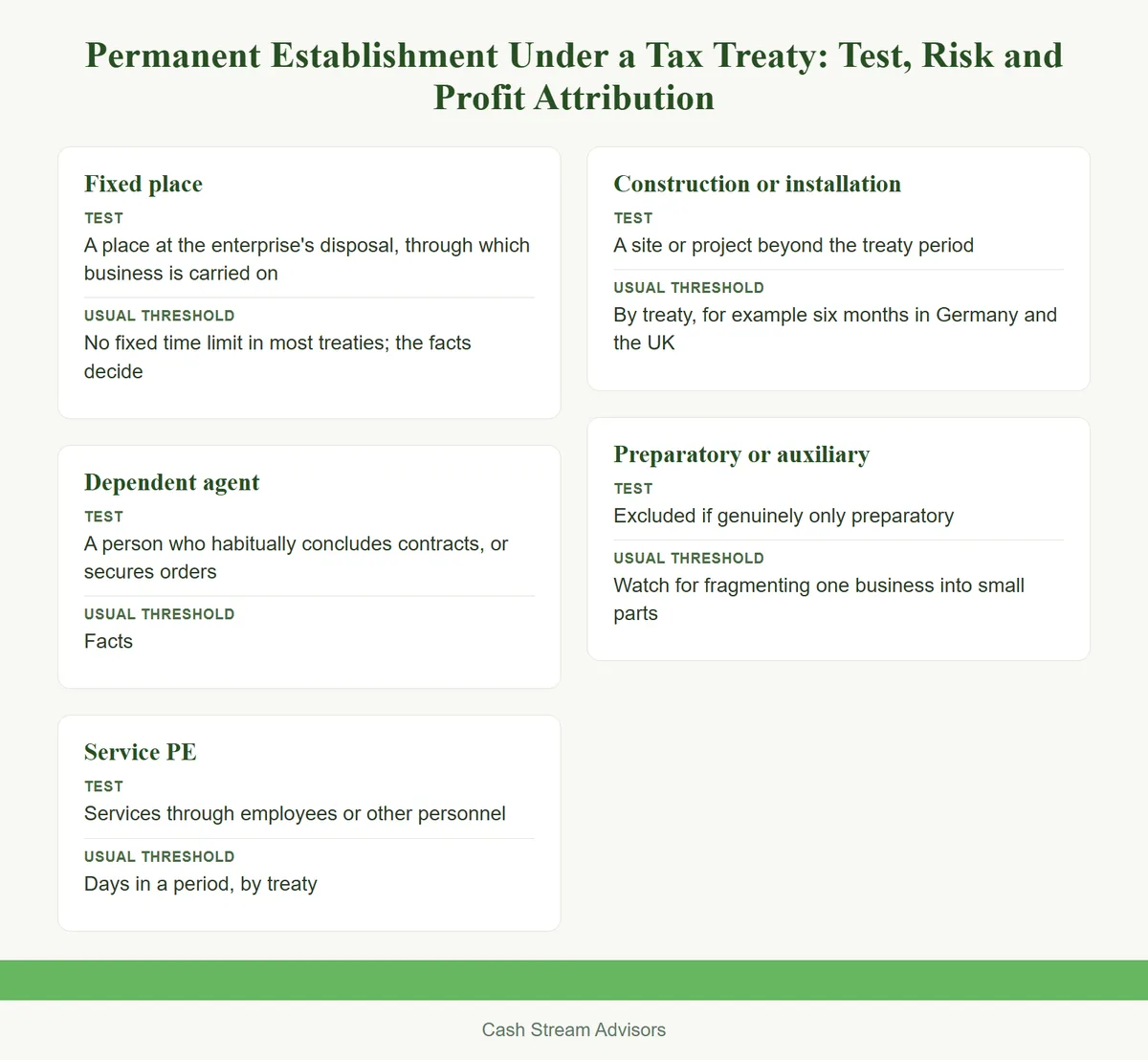
The permanent establishment meaning in practice: a fixed place can be an office, a desk at a customer's plant, or a hotel run by a foreign company. A dependent agent is not independent: it works mainly for the foreign company. The exclusion for preparatory work is lost where the activity is the core of the business.
Service PE days by treaty
The days differ by treaty, and some treaties have no service PE clause. The figures below were read on the treaty texts, but a protocol can change them, so read the treaty with the home country of the company.
| Treaty | Service PE days | Related or associated enterprise | Construction site |
|---|---|---|---|
| United States | More than 90 days in a 12-month period (Article 5(2)(l)) | A separate rule applies to services for a related person (Article 5(2)(l)) | More than 120 days in a 12-month period (Article 5(2)(k)) |
| United Kingdom | More than 90 days in any 12-month period (Article 5(2)(k)) | More than 30 days in any 12-month period | More than six months (Article 5(2)(j)) |
| Singapore | More than 90 days in a fiscal year (Article 5(6)) | More than 30 days in a fiscal year | More than 183 days in a fiscal year (Article 5(3)) |
| Germany | No general service PE clause | Not applicable | Over six months |
Country detail is in India-USA DTAA: Treaty Rates, Forms and How to Claim Them, India-UK DTAA, India-Singapore DTAA and India-Germany DTAA. Checked on 23 November 2026.
What the courts have said recently
- •
Hyatt (Supreme Court, 24 July 2025). A Dubai company with strategic oversight agreements with hotels in India was held to have a fixed place PE under Article 5(1) of the India-UAE treaty. The Court said there is no standard formula, and looked at the company's control over day-to-day operations and its disposal of the premises through its employees.
- •
Hyatt (Delhi High Court Full Bench, 2024). A PE in India is taxable on income attributable to it even where the enterprise as a whole made a loss, because Article 7 treats the PE as a distinct enterprise. Reported at (2024) 340 CTR 633.
- •
Clifford Chance (Delhi High Court, 4 December 2025). Under Article 5(6)(a) of the India-Singapore treaty, a service PE needs physical presence in India. The Court rejected a "virtual service PE", and found that after excluding vacation and business development days, the firm's staff were in India for about 44 days, below the 90 days. ITA 353 and 354 of 2025.
How profit is attributed to a PE
India taxes only the profit attributable to the PE, as if the PE were a separate and independent enterprise. That is the rule in Article 7(2) of most treaties.
Attribution has three steps. First, a functions, assets and risks analysis: what the PE does in India, what assets it uses, what risks it carries. Second, a method: where income cannot be worked out accurately, the officer can estimate it on a reasonable basis, for example by a percentage of turnover, or by apportioning global profit using India's share of receipts, under the methods in the Income-tax Rules (old Rule 10). Third, a computation and filing.
This is not transfer pricing. Transfer pricing prices transactions between related parties. Attribution decides how much profit belongs to the PE. The two can overlap but are separate exercises.
After the Full Bench in Hyatt, a loss-making foreign group cannot assume there is no Indian profit.
Illustration (hypothetical, not a client matter): a European contractor completes a project in India through a project office. Without an attribution study, the department could attribute a large share of the whole contract value as Indian profit. A study of what the project office did, which assets it used and what risks it bore supports a smaller share.
What having a PE costs and what to file
A PE is taxed as a foreign company. The tax rate for permanent establishment in India on business profits was a base rate of 35% for 2025-26, plus surcharge of up to 5% and 4% cess, which gives an effective rate of about 36.4% to 38.2%, as summarised by PwC. Confirm the rate for the year in question.
You will usually need:
- •
a PAN and a TAN;
- •
an income tax return in Form ITR-6;
- •
books of account and, where required, a tax audit;
- •
transfer pricing documentation where there are related-party dealings;
- •
TDS compliance where the PE pays others.
No PE certificate: what it is and when a payer asks for it
A no permanent establishment certificate is a declaration by the foreign company that it has no permanent establishment in India. Indian payers ask for it with the tax residency certificate and Form 41 before they pay at a treaty rate. It should say who the company is, which treaty applies, the period, and that it has no PE, and the facts should support it. A declaration that does not match the facts can be used against the company later. See Form 10F (Now Form 41): When You Need It and How to File It Online.
How to manage the risk
Our first questions to a client are:
- 1
Do you have an office, or a desk, anywhere in India?
- 2
Who is in India, for how long, and what do they do?
- 3
Does anyone here negotiate or conclude contracts for you?
- 4
Is there a project, and when does it start and end?
- 5
Does the Indian company or a subsidiary act for you?
Then route contracts so they are signed outside India, keep a day log of visits, and choose between a subsidiary and a branch with the tax result in mind. Keep the contracts, the day log and the project records. On permanent establishment risk, the day log is often the first thing an officer asks for.
On digital taxation, the significant economic presence rule in Indian law can tax a non-resident without a PE where thresholds of revenue or users are crossed, and a treaty may still protect it.
Talk to us
If you are a foreign company with an India footprint, or an Indian company hosting a foreign team, speak to us before the activity starts. Message us on WhatsApp or use our contact page.
Talk to an advisor
This Insights article is general information, not advice on a specific transaction. Read our disclaimer and regulatory compliance pages.
DTAA Advisory service
SERVICEForeign Company Tax Return in India
SERVICEInternational Taxation
INSIGHTSRoyalty vs Fees for Technical Services Under a Treaty: The Make Available Test
INSIGHTSWhat Is DTAA? How the Double Tax Avoidance Agreement Works in India
INSIGHTSTax Residency Certificate (TRC) for DTAA: Who Issues It and What India Needs
INSIGHTSForm 10F (Now Form 41): When You Need It and How to File It Online
INSIGHTSIndia-USA DTAA: Treaty Rates, Forms and How to Claim Them
INSIGHTSIndia-Germany DTAA: Treaty Rates, PE Risk and How to Claim
SERVICEAll insights
ABOUTAbout Cash Stream Advisors
CONTACTContact us
Official references
- Income-tax Act 2025, Section 159: agreement with foreign countries and treaty relief
- IRS: India tax treaty documents
- GOV.UK: India tax treaties (1993 convention, 2013 protocol and 2020 synthesised text)
- Income Tax Department: Singapore, comprehensive agreement and protocols
- Income Tax Department: Germany, comprehensive agreement
- SCC Online: Supreme Court ruling on Hyatt International Southwest Asia (24 July 2025)
- EY: Supreme Court on fixed place PE, Hyatt International (July 2025)
- Delhi High Court: CIT v. Clifford Chance Pte Ltd, ITA 353/2025 (4 December 2025)
DTAA Advisory
Treaty relief and TRC compliance for cross-border income., handled so it does not become the subject of your next article.