For years Mauritius was the quiet route for money going into India. A tax residency certificate and a licence were usually enough. That has changed in two steps: a Supreme Court judgment in January 2026, and a new Protocol that came into force in August 2026. This guide explains what the India Mauritius DTAA says now, and what a Mauritius entity must be ready to show.
The short answer
India and Mauritius signed their tax treaty in 1982. The 2024 Protocol, in force from 10 August 2026, adds a principal purpose test. A Mauritius tax residency certificate no longer settles the claim by itself: the Supreme Court held in January 2026 that substance and control matter. Shares bought before 1 April 2017 keep treaty protection. For the papers, read Tax Residency Certificate (TRC) for DTAA: Who Issues It and What India Needs and Form 10F (Now Form 41): When You Need It and How to File It Online.
Who this affects
- •
A Mauritius fund or holding company with Indian investments.
- •
A foreign investor that routes India money through Mauritius.
- •
An Indian company paying interest, royalties or fees to a Mauritius entity.
Rates at a glance
A treaty rate caps India's tax. Surcharge and cess are not added to a treaty rate. For all countries side by side, read India DTAA Rates and Countries: Dividend, Interest, Royalty and Fees.
| Income | Treaty rate | Checked |
|---|---|---|
| Dividends | 5% if the company holds 10% or more; 15% otherwise | 23 Nov 2026 |
| Interest | 7.5% | 23 Nov 2026 |
| Royalties | 15% | 23 Nov 2026 |
| Fees for technical services | 10% | 23 Nov 2026 |
| Business profits | Taxed in India only through a permanent establishment | 23 Nov 2026 |
| Capital gains on shares | Shares bought before 1 April 2017: grandfathered, taxable only in Mauritius. Shares bought from 1 April 2017 to 31 March 2019: India may tax at a reduced rate, subject to conditions. Later shares: taxable in India | 23 Nov 2026 |
Grandfathering and the 2017 line
The 2016 protocol moved the taxing right on gains from Indian company shares to India for shares bought on or after 1 April 2017. Shares bought earlier kept the old Mauritius-only treatment. The CBDT said in Circular 01/2025 of 21 January 2025 that the principal purpose test does not touch that grandfathered position.
The Tiger Global judgment raised a concern that the general anti-avoidance rule could reach benefits arising after 1 April 2017 even on earlier investments. On 31 March 2026 the CBDT answered by amending the rules (Rule 10U of the 1962 Rules, and Rule 128 of the Income-tax Rules 2026): GAAR does not apply to income from the transfer of investments made before 1 April 2017. That protects the gain. It does not remove the need for substance on newer investments.
How to claim from India
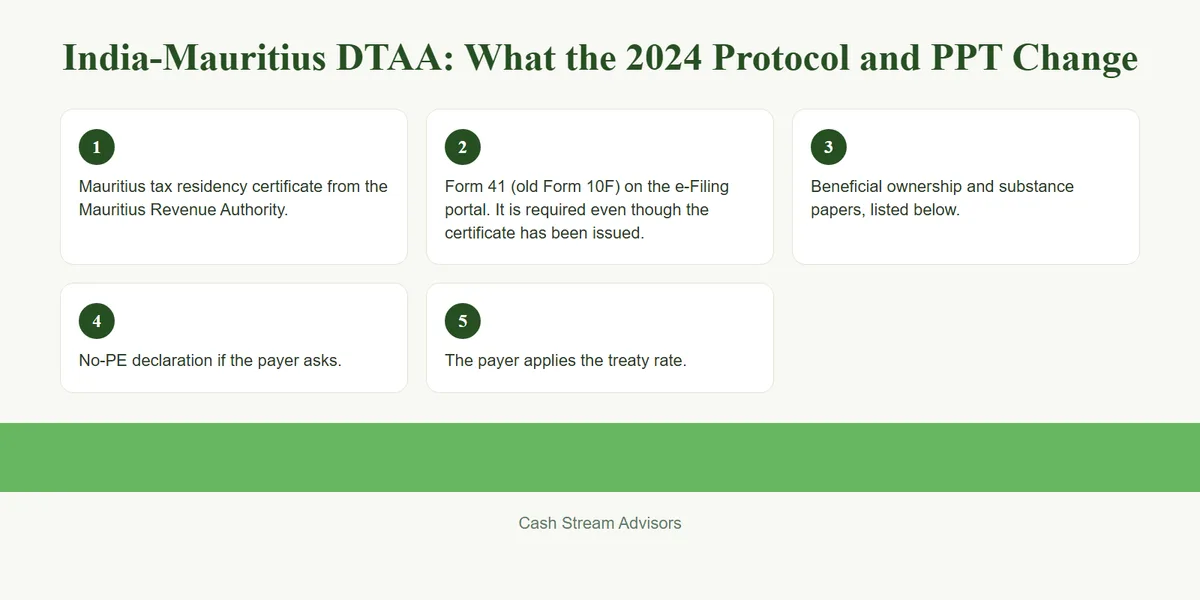
- 1
Mauritius tax residency certificate from the Mauritius Revenue Authority.
- 2
Form 41 (old Form 10F) on the e-Filing portal. It is required even though the certificate has been issued.
- 3
Beneficial ownership and substance papers, listed below.
- 4
No-PE declaration if the payer asks.
- 5
The payer applies the treaty rate.
The Global Business Licence
A Mauritius company that is run as a global business holds a Global Business Licence from the Financial Services Commission, alongside the tax residency certificate. Both are needed, and neither is enough alone, as Tiger Global showed.
Substance papers
Hold these before you claim:
- •
Names of the office managers and the people who run the company in Mauritius.
- •
Proof of expenses actually incurred there.
- •
Proof that the business is operated in Mauritius, not only registered there.
- •
Audited financial statements.
The principal purpose test and Tiger Global
The 2024 Protocol adds Article 27B. A benefit can be denied if it was one of the principal purposes of an arrangement, unless granting it fits the treaty's object and purpose. It is not a Multilateral Instrument covered agreement, so it applies through the Protocol itself. India notified the Protocol on 13 October 2026 (S.O. 5611(E)), and it applies from 10 August 2026 regardless of the taxable year.
In Tiger Global (Supreme Court, 15 January 2026), the Court held that a tax residency certificate is required but not conclusive. The authorities may look at where effective control and management reside, the commercial rationale and whether the entity does real economic work. The Mauritius entities held valid certificates and Category 1 Global Business Licences, yet were held not entitled to the exemption, with weight placed on the control exercised from the United States and the lack of commercial substance. The Court also held that Circular 789, which had treated the certificate as sufficient, no longer binds where abuse is alleged.
Interest, royalties and fees for Indian payers
A payer should not apply the treaty rate on a certificate alone. Check the certificate period, Form 41, the beneficial owner and the substance papers before the payment, and record the checks.
Illustration (hypothetical, not a client matter): an Indian company pays interest to a Mauritius lender that is owned by a foreign parent, with no staff or office of its own in Mauritius and decisions taken abroad. The certificate is valid. After Tiger Global, the payer and the officer would both ask who really controls the lender. A lender with real directors, an office and records in Mauritius is better placed.
Where claims go wrong
- 1
Relying on the certificate alone. Fix: hold the substance papers too.
- 2
A shell with no operations. Fix: show real office, people and spending in Mauritius.
- 3
Control from outside Mauritius. Fix: hold board meetings and decisions there.
- 4
Assuming post-2017 shares are protected like earlier ones. Fix: test substance before you claim.
- 5
A Form 41 filed with errors. Fix: check it before filing, because errors can surface only at assessment.
Talk to us
If you hold or plan to hold Indian assets through Mauritius, talk to us before the transaction. Message us on WhatsApp.
Talk to an advisor
This Insights article is general information, not advice on a specific transaction. Read our disclaimer and regulatory compliance pages.
DTAA Advisory service
INSIGHTSTax Residency Certificate (TRC) for DTAA: Who Issues It and What India Needs
INSIGHTSForm 10F (Now Form 41): When You Need It and How to File It Online
INSIGHTSIndia DTAA Rates and Countries: Dividend, Interest, Royalty and Fees
INSIGHTSRoyalty vs Fees for Technical Services Under a Treaty: The Make Available Test
INSIGHTSIndia-Singapore DTAA: Treaty Rates, Capital Gains and How to Claim
SERVICEAll insights
ABOUTAbout Cash Stream Advisors
CONTACTContact us
Official references
- Income Tax Department: Mauritius, comprehensive agreement and protocols
- Income Tax Department: Notification No. 135/2026 (India-Mauritius Protocol)
- DLA Piper: Supreme Court ruling on Tiger Global, tax treaty eligibility and indirect share transfers
- Income-tax Act 2025, Section 159: agreement with foreign countries and treaty relief
- Income-tax Rules 2026, Rule 75: documents for claiming relief under Section 159
DTAA Advisory
Treaty relief and TRC compliance for cross-border income., handled so it does not become the subject of your next article.