Missed an FC-GPR, FC-TRS or FLA deadline? See when the RBI late submission fee works, when compounding is needed, and what each route costs.
A company finds out in the middle of a funding round that the FC-GPR was never filed, or that the FLA return slipped past 15 July. The first question is always the same: can this be fixed with a fee, or does it need compounding? Searching for "missed RBI reporting deadline late fee or compounding"? This is how we sort the two routes.
Which route are you on?
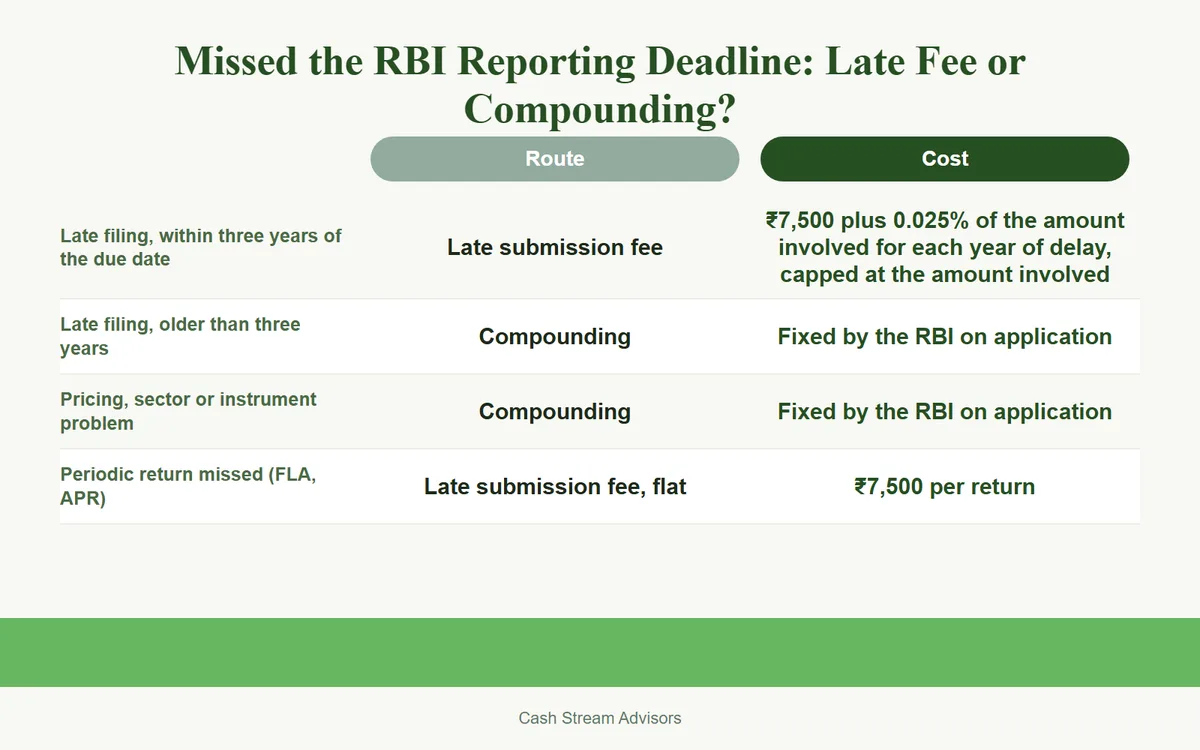
In our files, roughly seven in ten late filings are plain late submission fee cases. The rest go to compounding. No outcome can be promised in either, but the table shows the usual split.
| Situation | Route | Cost | Where |
|---|---|---|---|
| Late filing, within three years of the due date | Late submission fee | ₹7,500 plus 0.025% of the amount involved for each year of delay, capped at the amount involved | Applied for through the AD bank |
| Late filing, older than three years | Compounding | Fixed by the RBI on application | Application to the RBI, online through its PRAVAAH portal |
| Pricing, sector or instrument problem | Compounding | Fixed by the RBI on application | Application to the RBI |
| Periodic return missed (FLA, APR) | Late submission fee, flat | ₹7,500 per return | Within three years of the due date |
The FC-GPR late submission fee, worked through
Late submission fee FEMA cases follow one formula. The FEMA late submission fee (LSF) is the RBI's standard way to regularise a late report. For FC-GPR, FC-TRS and similar returns, the fee is ₹7,500 plus 0.025% of the amount involved multiplied by the years of delay. This is the LSF FEMA calculation as set by the RBI circular of 30 September 2022. Delay is counted from the due date, rounded up to the month, and shown to two decimal places. The fee is never less than ₹7,500, and never more than 100% of the amount involved.
Illustration, not a client case. Say ₹1 crore was received from a foreign investor and the FC-GPR was filed 14 months after the due date.
- 1
Delay: 14 months is 1.17 years.
- 2
Variable part: 0.025% of ₹1,00,00,000 is ₹2,500. Multiplied by 1.17, it is ₹2,925.
- 3
Total: ₹7,500 plus ₹2,925 is ₹10,425.
Two points on timing. The AD bank asks for the due date of submission and the date of actual filing. Once the fee advice is issued, it must be paid within 30 days, or it lapses and a fresh application is needed. A fresh application can raise the fee, because the delay is counted again from the new date. For the portal steps, read How to File FC-GPR on the FIRMS Portal.
When FEMA compounding applies
FEMA compounding is the route when the matter is not just late. In our files three situations push a case there: the breach is older than three years, the issue is substantive such as the price or the instrument, or the sector is sensitive. Sectors such as atomic energy, defence and insurance draw more scrutiny than technology, and investments that fall under Press Note 3 draw more in any case.
The Foreign Exchange (Compounding Proceedings) Rules 2024 set the process, in outline. The company applies to the RBI online through its PRAVAAH portal, with the facts, the documents and the contravention, and pays an application fee of ₹10,000 plus GST, as applicable. The RBI examines the application and may call for more information. It then gives the company a hearing and passes an order fixing the amount, which under the Rules must come within 180 days of a complete application. The company pays within 15 days of the order, or it is treated as if it never applied. A contravention cannot be compounded if an order imposing a penalty under Section 13 of FEMA has already been passed. We advise on these cases individually. No result can be promised, and the outcome depends on the facts.
What to do this week
- 1
List every return that was missed: FC-GPR, FC-TRS, FLA, APR.
- 2
Check whether each is within three years of its due date.
- 3
Work out the fee with the formula above, or the flat ₹7,500 for periodic returns.
- 4
Gather the papers: the original documents, the due date and the filing date.
- 5
Speak to your AD bank, or a chartered accountant, before you apply.
Staying silent only lengthens the delay and raises the fee, so do not wait. Rejections are another matter: read Why FC-GPR Gets Rejected. For the FLA return, read FLA Return: Who Must File and By When.
How we help
We list what was missed, work out which route applies, prepare the late submission fee application with the AD bank, and advise on compounding where the case needs it. Missed a deadline and not sure which route? Book a Consultation. See also our FC-GPR service.
Talk to an advisor
Missed a reporting deadline? Speak to us before you apply. Book a Consultation, message us on WhatsApp, or write to us by email.
This Insights article is general information, not advice on a specific transaction. Read our disclaimer and regulatory compliance pages.
Form FC / RBI reporting service
INSIGHTSWhy FC-GPR Gets Rejected: 6 Real Reasons and How to Fix Each
INSIGHTSFC-GPR vs FC-TRS vs FLA Return: Which RBI Form Applies to You?
INSIGHTSHow to File FC-GPR on the FIRMS Portal: Step by Step
INSIGHTSFLA Return: Who Must File and by When (RBI)
SERVICEAll insights
ABOUTAbout Cash Stream Advisors
CONTACTContact us
Official references
Form FC / RBI Reporting
FIRMS portal filing and your recurring RBI compliance calendar., handled so it does not become the subject of your next article.