Behind on bookkeeping? What catch-up involves, what you need to send, how long it takes by backlog, and where catch-ups go wrong.
The call usually starts the same way. An owner says, "I am behind on bookkeeping, and I am not sure how far." Sometimes it is two months. Sometimes it is three years, with a return due next month. The work is the same either way: bring the books current, in an order that can be checked at every step.
Catch-up or cleanup?
Catch up bookkeeping fills in what is missing. Bookkeeping cleanup fixes what is wrong. Many files need both, and we do the catch-up first.
Our first test is simple: are your bank statements entered in your books up to date? If they are not, that is the red flag, and getting the bank side current comes before anything else.
| Your situation | What you need | Quick test |
|---|---|---|
| Months with nothing entered | Catch-up | Is the latest bank statement month missing from your books? |
| Entries exist but numbers do not tie | Cleanup | Do customer balances match what customers say they paid? |
| Both, or a half-finished earlier attempt | Catch-up and cleanup | Is the bank side behind and are the balances also wrong? |
For what a clean monthly routine looks like afterwards, read Month-End Close Checklist for Small Businesses: A Working Routine.
How to catch up on bookkeeping, step by step
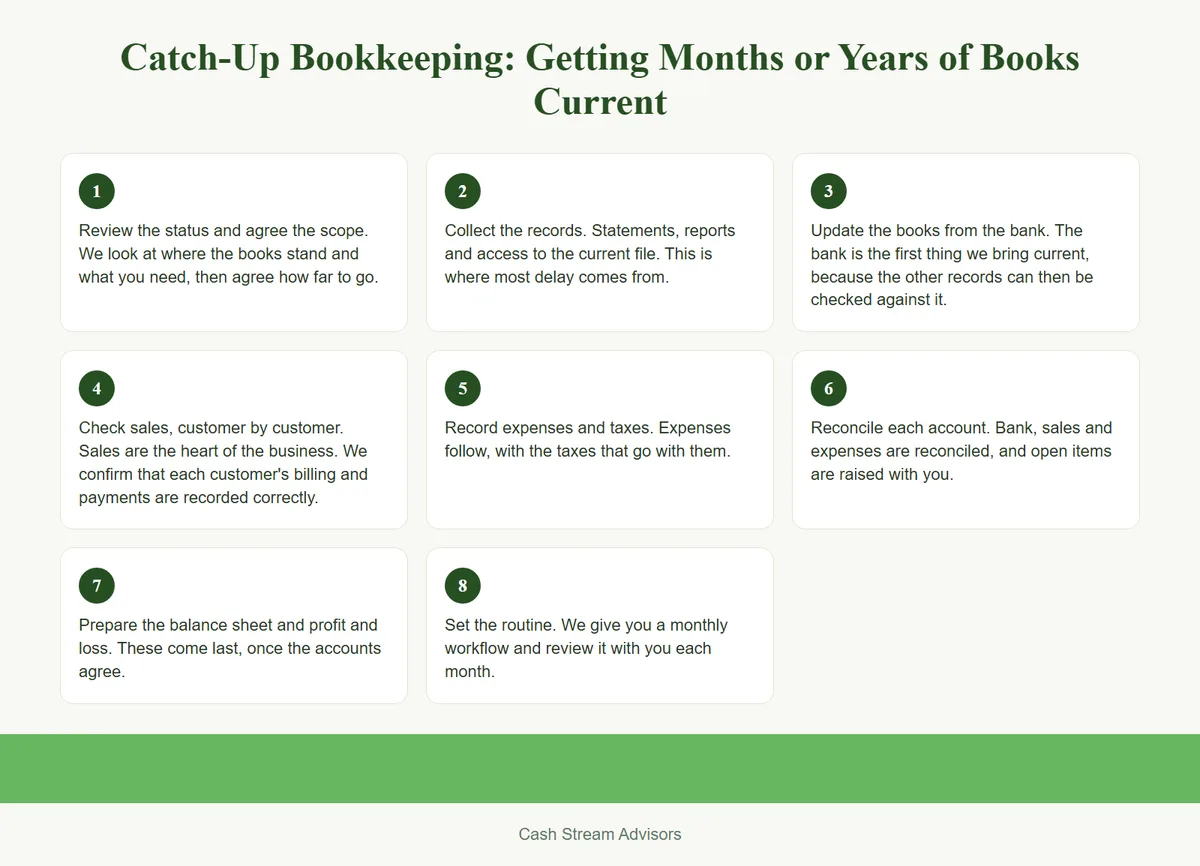
We work in this order, so that each step can be checked against the one before it.
- 1
Review the status and agree the scope. We look at where the books stand and what you need, then agree how far to go.
- 2
Collect the records. Statements, reports and access to the current file. This is where most delay comes from.
- 3
Update the books from the bank. The bank is the first thing we bring current, because the other records can then be checked against it.
- 4
Check sales, customer by customer. Sales are the heart of the business. We confirm that each customer's billing and payments are recorded correctly.
- 5
Record expenses and taxes. Expenses follow, with the taxes that go with them.
- 6
Reconcile each account. Bank, sales and expenses are reconciled, and open items are raised with you.
- 7
Prepare the balance sheet and profit and loss. These come last, once the accounts agree.
- 8
Set the routine. We give you a monthly workflow and review it with you each month.
We run this fortnightly, or monthly if that suits you better, in QuickBooks Online, Zoho Books or Xero. If a reconciliation will not match at step 6, read Bank Reconciliation Not Matching? Common Errors and How to Fix Them.
What we need from you
- •
Statements for every bank and credit card account
- •
Loan and payroll reports
- •
Payment-processor reports
- •
Prior returns
- •
Access to the current file or spreadsheets
- •
Receipts for business spending paid from a personal account or card
The item that arrives late most often is the last one: receipts for business spending that went through a personal account or card. Send what you have, and we will list what is missing.
How long a bookkeeping catch up takes
It depends on how fast the records arrive. For a backlog of one to three months, the slowest part is collecting the documents. The other steps move faster once the records are in. A longer backlog means more statements, more accounts and more questions to settle, so it takes longer.
We do not give a fixed time for each size of backlog, because the records decide it. One file gives a fair picture: twelve months of books, started in January, ended with a filed return in the first week of March. That is about two months from the start of the work to the return.
Where catch-ups go wrong
Most trouble shows up at reconciliation, in what was never sent or never recorded.
- •
Documents arrive late. Collecting the paperwork takes longer than the accounting. Every month of delay is a month the books stay behind.
- •
Business spending through personal accounts and cards. Receipts arrive late, so expenses are missing, and the reconciliation shows gaps that look like errors.
- •
Customer payments not recorded. A customer has paid, but the payment is not posted against their balance. The receivables ledger then shows money as owed that has already been received.
- •
Wrong opening balances. A catch-up starts from the balances you had on the first day of the gap. If they are wrong, every month after carries the same error, so we check them as part of the work and do not assume them.
- •
An earlier half-finished attempt. Some months are entered and some are not, and the entries that exist may not tie. That is catch-up and cleanup together.
We try to catch the receivables problem early, because it spreads into every later report.
Working with a team across time zones
You deal with one person directly, who is the single point of contact for your file. We work on New York hours. Documents are shared over a secured network folder.
On data: we handle your data in line with India's Digital Personal Data Protection (DPDP) Act, and we do not give third parties access to it. It stays between you and us. Once you have taken a backup, we delete the data on a yearly basis. For what the first months look like, read What to Expect When You Outsource Your Bookkeeping.
Behind on books and taxes?
Which comes first depends on the deadlines. The IRS tax return is the urgent one, so we start with the books that return needs and file it first, because we do not file a return on unfinished books. If time is short, we explain the options and any penalty before going further. For doing both together, read Why Your Books Must Be Ready Before Your Tax Return Is Filed.
A catch-up, in practice
An owner came to us twelve months behind. His tax return was due in April. We started in January, brought the twelve months current by the end of February, and filed the return in the first week of March. The year held between 5,000 and 10,000 transaction lines, so we automated much of the work.
No late-filing penalty was imposed, and the owner met the deadline. Alongside the books, we gave him a monthly workflow to keep them current, and we review them with him each month. This is what happened in one file. The timing of another will depend on its records.
Talk to an advisor
If you are behind on your books, message us on WhatsApp for a quote, book a consultation, or write to contact@cashstreamadvisors.com.
This Insights article is general information, not advice on a specific transaction. Read our disclaimer and regulatory compliance pages.
US bookkeeping service
INSIGHTSWhat to Expect When You Outsource Your Bookkeeping
INSIGHTSWhy Your Books Must Be Ready Before Your Tax Return Is Filed
INSIGHTSQuickBooks vs Zoho Books vs Xero: Which Suits a Small Business
INSIGHTSMonth-End Close Checklist for Small Businesses: A Working Routine
SERVICEAll insights
ABOUTAbout Cash Stream Advisors
CONTACTContact us
Bookkeeping
Monthly books, catch-up and cleanup, and tax filing in QuickBooks, Zoho Books or Xero., handled so it does not become the subject of your next article.