
Onboarding, system access, the monthly cycle and working-hour overlap: what really happens in the first months of outsourced bookkeeping.
Handing your books to someone else is a small act of trust, and most owners want to know three things before they do it: what happens first, what they still have to do, and who they can reach. Outsourcing bookkeeping is easier when you know the shape of it, and owners who decide to outsource bookkeeping usually feel better once they have seen it written down. Here it is, from the first call to the monthly rhythm.
Before day one
Onboarding starts with a discovery call. We ask about the nature of your business, the state of your bookkeeping to date, your previous consultant, and why you are moving. We then send an information request list, which is a checklist of what we need. When you are ready, we sign an engagement letter, and the first days of work begin.
Missing statements and delayed access are what slow it down.
The first 30 days
We start with the basics, then go step by step: bank statements, vendor invoices, opening balance reconciliation, sales reconciliations, trade receivable reconciliation, accounts payable reconciliation, and a review of the chart of accounts.
If your books are behind, a catch-up comes first. In one file the owner was twelve months behind. We began in January, brought the twelve months current by the end of February, and the return went in during the first week of March. This is one file, not a promise. For the full process, read Catch-Up Bookkeeping: Getting Months or Years of Books Current.
The monthly rhythm
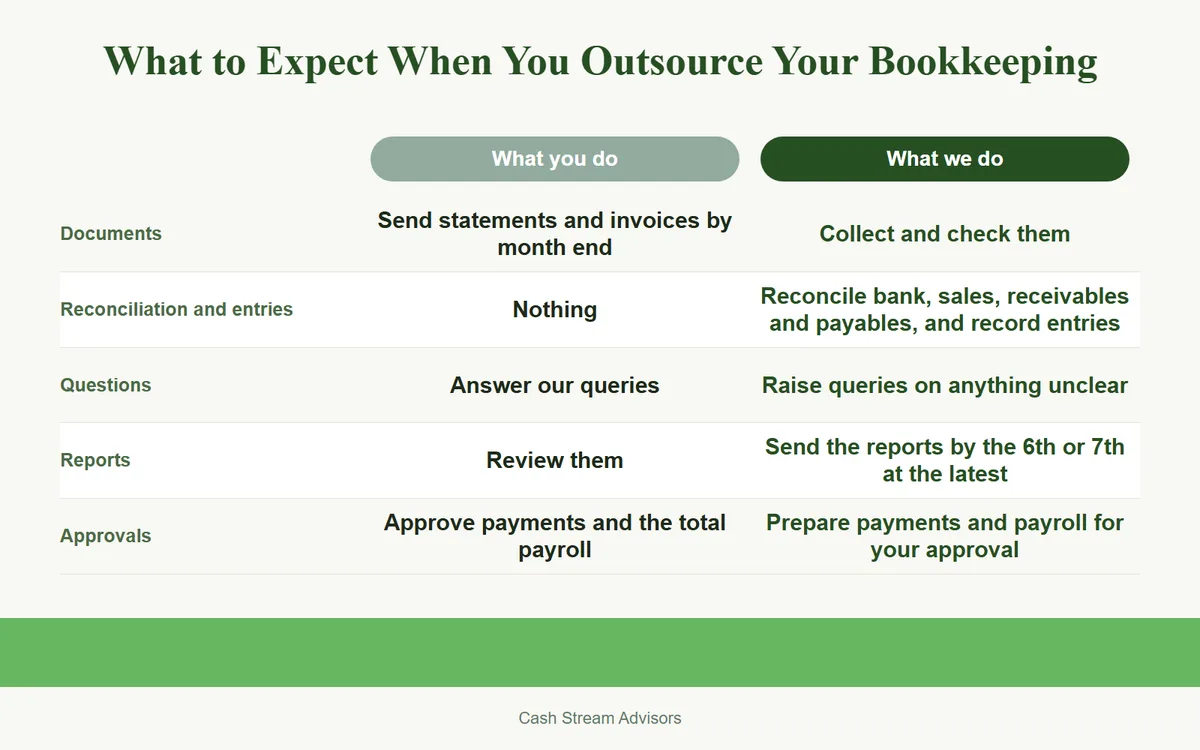
Documents come to us by the last day of the month. The reports go back by the 6th or 7th at the latest.
| Step | What you do | What we do |
|---|---|---|
| Documents | Send statements and invoices by month end | Collect and check them |
| Reconciliation and entries | Nothing | Reconcile bank, sales, receivables and payables, and record entries |
| Questions | Answer our queries | Raise queries on anything unclear |
| Reports | Review them | Send the reports by the 6th or 7th at the latest |
| Approvals | Approve payments and the total payroll | Prepare payments and payroll for your approval |
The routine behind it is in Month-End Close Checklist for Small Businesses: A Working Routine.
What you still do
- •
Send your documents by the end of the month
- •
Answer our questions
- •
Approve payments and the total payroll amount
Some owners also keep track of their receivables themselves. You keep your own login, and ownership of the books stays with you at all times. You see the overall picture each month, without handling the day-to-day entries.
Working hours and where the team sits
Our team is in India and works on New York hours. We serve clients across the US. You deal with one person directly, who is your single point of contact. We do not promise a fixed response time. If you are on the West Coast or in Hawaii, ask us about the overlap before you sign, so you know what to expect. The time we spend live with you goes on review and understanding. For the choice of software, read QuickBooks vs Zoho Books vs Xero: Which Suits a Small Business.
Questions about safety and control
Documents are shared over a secured network folder. We do not give third parties access to your data. We handle data in line with India's Digital Personal Data Protection (DPDP) Act. Once you have taken a backup, we delete the data on a yearly basis. We ask for accountant-level access to your software, with view access and, in some cases, edit access to make entries. Nothing is locked in: the books are yours, and you can take them whenever you choose.
Talk to an advisor
If you are ready to talk, message us on WhatsApp, book a consultation, or write to contact@cashstreamadvisors.com.
This Insights article is general information, not advice on a specific transaction. Read our disclaimer and regulatory compliance pages.
Bookkeeping
Monthly books, catch-up and cleanup, and tax filing in QuickBooks, Zoho Books or Xero., handled so it does not become the subject of your next article.