Filing on unfinished books means estimates, missed deductions and amended returns. What a return pulls from your books and how to be ready.
Sooner or later an owner asks the question: the return is due, the books are not finished, can we just file with what there is? We can see why they ask. But a return is only a summary of the books, and a summary of unfinished books is a guess. Bookkeeping before tax return is the order we work in, and this is why.
What a tax return pulls from your books
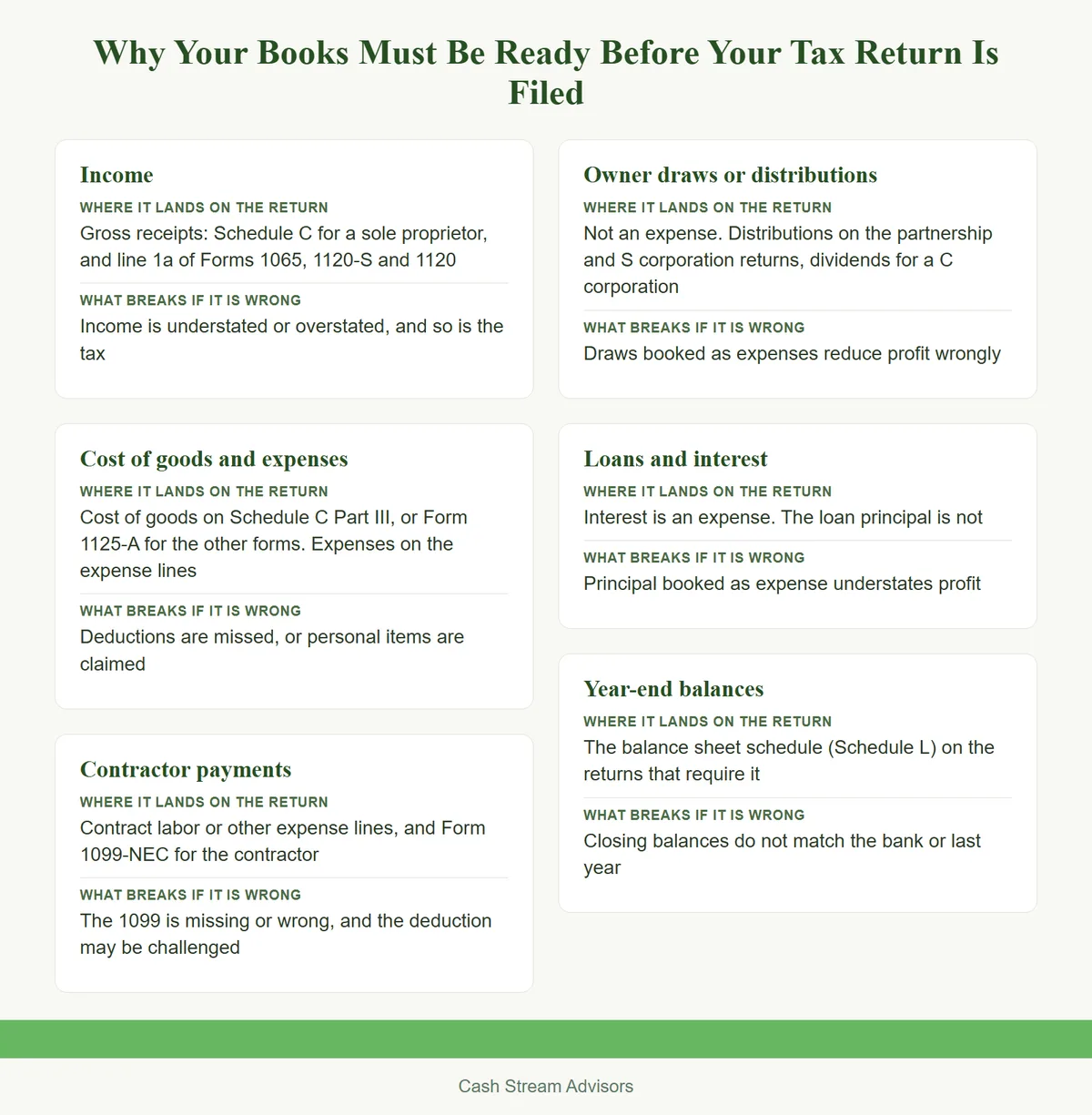
The return is a summary of your books, so a wrong book figure becomes a wrong return line. This table shows where the main figures land. We serve sole proprietors, partnerships, S corporations and C corporations. Line numbers and forms change from year to year, so check the IRS instructions for your tax year.
| Book figure | Where it lands on the return | What breaks if it is wrong |
|---|---|---|
| Income | Gross receipts: Schedule C for a sole proprietor, and line 1a of Forms 1065, 1120-S and 1120 | Income is understated or overstated, and so is the tax |
| Cost of goods and expenses | Cost of goods on Schedule C Part III, or Form 1125-A for the other forms. Expenses on the expense lines | Deductions are missed, or personal items are claimed |
| Contractor payments | Contract labor or other expense lines, and Form 1099-NEC for the contractor | The 1099 is missing or wrong, and the deduction may be challenged |
| Owner draws or distributions | Not an expense. Distributions on the partnership and S corporation returns, dividends for a C corporation | Draws booked as expenses reduce profit wrongly |
| Loans and interest | Interest is an expense. The loan principal is not | Principal booked as expense understates profit |
| Year-end balances | The balance sheet schedule (Schedule L) on the returns that require it | Closing balances do not match the bank or last year |
One number deserves a note. For payments made after 31 December 2025, the Form 1099-NEC reporting threshold is $2,000, up from $600, according to the IRS instructions for Forms 1099-MISC and 1099-NEC. The monthly routine that keeps these figures right is in Month-End Close Checklist for Small Businesses: A Working Routine.
What goes wrong when the books are not ready
Five failures cause most of the trouble at filing time. Each has a fix.
- 1
Estimated figures, replaced later. The return is built on estimates because the books are unfinished. When the real figures arrive, the return changes. Fix: finish and reconcile the books first.
- 2
Owner transactions inside expenses. Draws, personal payments or owner loans sit in expense accounts. Profit is understated, and the return is wrong. Fix: move them to equity or loan accounts and re-check the totals.
- 3
Contractor payments with no record. There is no W-9, no total by contractor, and no 1099. Fix: build the list of payments by contractor from the bank and collect the missing details.
- 4
Closing balances that do not match. The year-end balance differs from the bank or from last year's return. Fix: reconcile and trace the difference. See Bank Reconciliation Not Matching? Common Errors and How to Fix Them.
- 5
Personal spending mixed in. Personal items sit in business accounts, which makes expenses unreliable. Fix: separate and reclassify them with the owner.
In one file the owner was twelve months behind, with the return due in April. We started in January, brought the twelve months current by the end of February, and filed in the first week of March. The books came first, then the return. This is one file, not a promise of timing.
Tax ready bookkeeping: the short list
Tax ready bookkeeping means these five things are true before anyone opens the return.
- •
Every bank and card account reconciled
- •
Every transaction categorised
- •
Contractor and payroll records matched
- •
Last year's closing balances carried forward
- •
All documents in one place
Our monthly close keeps this list current all year. The routine is in the Month-End Close Checklist article.
Why one team doing both helps
When the same team keeps the books and prepares the return, there is no hand-off and no re-keying, and questions are answered once. You stop overseeing the details but still see the full picture, end to end. We file US returns end to end for all entity types, signed by a professional tax preparer who holds a PTIN, in most cases an EA or a CPA.
Extensions are part of the work when a client faces an emergency or an unforeseen circumstance. If the books cannot be finished by the deadline, we explain the options and any penalty to the client, then finish the books before filing. Two points are worth knowing. Individual returns, including a sole proprietor's, are extended on Form 4868, and business returns on Form 7004. And an extension of time to file is not an extension of time to pay, as the IRS says on its extension page. For what the first months with us look like, read What to Expect When You Outsource Your Bookkeeping.
Months or years behind?
If more than about a year is open, it is a catch-up job first, and then the return. We do not file on unfinished books. For how a catch-up runs, read Catch-Up Bookkeeping: Getting Months or Years of Books Current.
Talk to an advisor
If you want the books and the return handled together, message us on WhatsApp for a quote, book a consultation, or write to contact@cashstreamadvisors.com.
This Insights article is general information, not advice on a specific transaction. Read our disclaimer and regulatory compliance pages.
Official references
Bookkeeping
Monthly books, catch-up and cleanup, and tax filing in QuickBooks, Zoho Books or Xero., handled so it does not become the subject of your next article.